


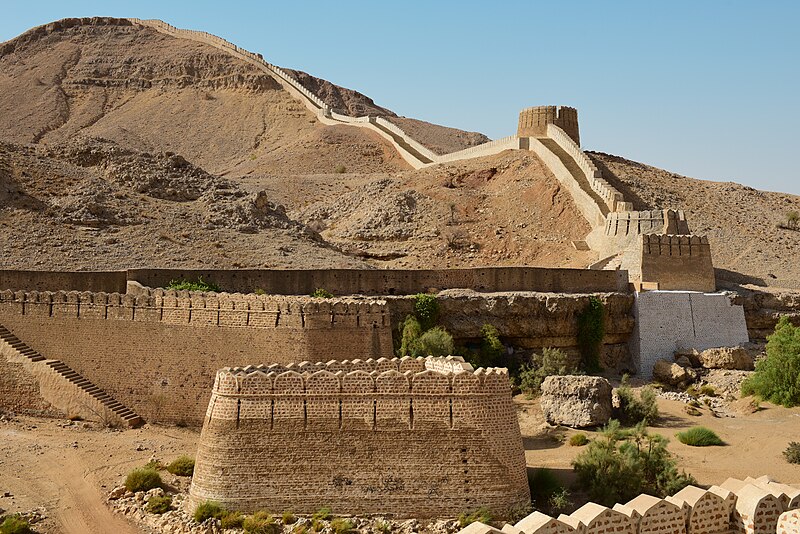
Ranikot Fort, often dubbed as the “Great Wall of Sindh,” is one of Pakistan’s most fascinating and enigmatic historical landmarks. Situated near the town of Sann in Jamshoro District, Sindh, the fort is recognized as one of the largest in the world, with a perimeter of around 32 kilometers (20 miles). Despite its immense size and strategic location, much about its origins remains a mystery, adding to its allure and significance as a cultural and historical monument.


Historical Background
Ranikot Fort is believed to have been originally constructed in the first half of the 17th century, though there are varying accounts about its exact origins. Some historians suggest that it may date back even further, to the reign of the Sassanian Empire or earlier. It was later renovated and expanded during the rule of the Talpur Mirs in the early 19th century, as they sought to fortify their domain against external threats.
The purpose of the fort, however, remains unclear. While some believe it was built as a defense against invasions, others argue that it was a means of securing trade routes or serving as a safe haven for local rulers. The lack of any major historical records associated with significant battles or sieges at Ranikot adds to the ambiguity surrounding its function.
Architectural Marvel
The scale of Ranikot is staggering, covering an area of approximately 32 square kilometers. The fort’s massive walls snake across the barren landscape, resembling the Great Wall of China, with which it is often compared. Constructed from limestone and sandstone, the fort’s walls rise up to 6 meters (20 feet) in height and are punctuated by several bastions and watchtowers.
Ranikot has four main gates: Sann Gate, Amri Gate, Shah-Pere Gate, and Mohan Gate, each offering access to different sections of the fort. The Sann Gate, located on the eastern side, is the main entrance and is notable for its intricate design and stonework.
Within the fort’s vast expanse lies another fortification known as the “Meeri” or “Mirikot,” a small fort within the larger walls that served as the residence of the Talpur Mirs. This inner fort has its own gates and walls, adding an additional layer of defense. The Meeri Fort is perched on a hill, providing a commanding view of the surrounding landscape.
The Great Wall of Sindh
The fort’s walls, stretching across the arid hills, resemble a smaller version of the Great Wall of China. This feature has earned Ranikot the nickname “The Great Wall of Sindh.” The zigzagging walls extend for miles, blending into the rocky terrain, and are a stunning sight, especially at sunrise or sunset when the golden light casts long shadows over the surrounding desert.
Unlike the Great Wall of China, however, Ranikot is not located in a highly populated or strategically important area. Its remote location has contributed to the fort’s air of mystery, as well as its relative obscurity in the global historical and architectural landscape.
Mysteries and Theories
The true purpose of Ranikot Fort is still shrouded in mystery. Scholars and historians have proposed various theories about why it was built, ranging from a defense structure against invasions from Central Asia to a royal retreat for the Talpur dynasty. Some suggest that it was intended to protect the local population from bandits and raiders, while others believe it may have been a strategic point for controlling trade routes passing through the region.
One of the most intriguing aspects of Ranikot is the lack of significant historical records or evidence of major battles taking place there. Its size and scale suggest that it must have had some important function, yet it remains an enigma to this day.
Cultural Significance
Ranikot Fort is not only an architectural marvel but also a cultural treasure. It stands as a testament to the rich history of Sindh, a region that has been home to ancient civilizations, including the Indus Valley Civilization. The fort’s design reflects the influences of various dynasties and cultures that have ruled over Sindh, from the Greeks and Mauryas to the Mughals and Talpurs.
In modern times, Ranikot has gained recognition as a symbol of Sindh’s historical heritage. The fort has been nominated for inclusion in UNESCO’s World Heritage Sites list, which would help preserve and promote this incredible site on a global stage.


