


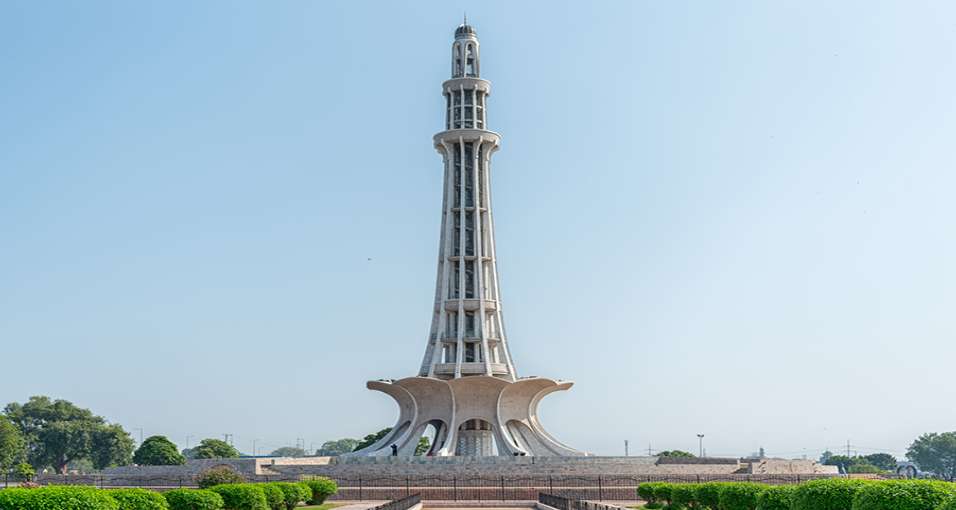
| Location Coordinates Status Type Construction started Completed Height Architect(s) Structural engineer Contractor | Lahore, Pakistan 31° 35′ 33″ N, 74° 18′ 34.2″ E National Tower of Pakistan Public monument 1960 1968 Roof 62 metres (203 ft) Naseer-ud-din Murat Khan Abdur Rehman Khan Niazi Mian Abdul Khaliq Company |
Minar-e-Pakistan stands tall and resolute within Iqbal Park, Lahore, commemorating the historic Pakistan Resolution. This striking minaret, a fusion of Mughal and contemporary architecture, stands proudly on the very ground where the Muslim League, on March 23, 1940, voiced the Pakistan Resolution—seven years before the formal inception of Pakistan. This landmark declaration called for the establishment of a separate homeland for South Asia’s Muslims, a day now celebrated annually as a national holiday in Pakistan.
Drawing crowds from across the country and the bustling Walled City of Lahore, the monument’s vast public space serves as a hub for political assemblies and public gatherings. The surrounding Iqbal Park area also holds its own allure, popular among kite enthusiasts and those seeking leisure.
Design and Construction:
The architectural vision of Minar-e-Pakistan was crafted pro bono by Nasreddin Murat-Khan, an architect/engineer from Daghestan, Russia, alongside Usman Khan, an architect/engineer from Sargodha, Pakistan. Supported by structural engineer Abdur Rehman Khan Niazi, the design, approved by President Mohammad Ayub Khan, was materialized by Mian Abdul Khaliq and Company, the contracting entity.
The foundation stone was laid on March 23, 1960, and the meticulous construction spanned eight years, culminating in its completion on October 31, 1968, with an estimated cost of Rs. 7.5 million. Funding for this iconic structure was amassed through a supplemental tax on cinema and horse racing tickets. Visitors today can savor a panoramic view by climbing stairs or using an elevator, while the surrounding parks feature marble fountains and an artificial lake.

Structure and Inscriptions:
Ascending 60 meters above an 8-meter base, the minaret stands approximately 72 meters high. The base, resembling unfolding flower petals, towers at 9 meters. Its diameter stretches about 97.5 meters (320 feet), featuring a base platform shaped like a five-pointed star encompassing two crescent-shaped pools.
Constructed from reinforced concrete, stones, and marble, the structure embodies intricately patterned tiles at the rostrum, facing the grand Badshahi Mosque. Comprising four platforms, each signifies different stages of the freedom struggle, utilizing Taxila stones, hammer-dressed stones, chiseled stones, and polished white marble to represent the triumph of the Pakistan Movement.
Inscriptions and Environmental Concerns:
Ten converging white marble plaques at the base bear floral inscriptions, including the Lahore Resolution in Urdu, Bengali, and English, as well as the Delhi Resolution passed on April 9, 1946. These plaques also feature Quranic Verses, attributes of ALLAH, the National Anthem of Pakistan in Urdu and Bengali, excerpts from Mohammad Ali Jinnah’s speeches, and verses by Allama Iqbal in multiple languages.
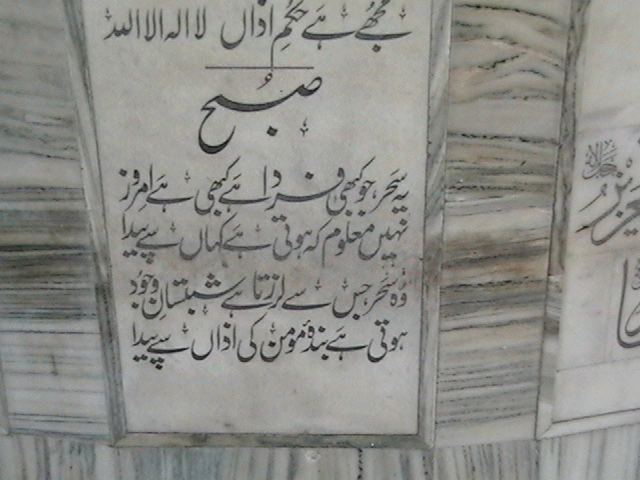
While Minar-e-Pakistan remains a revered symbol, the monument faces environmental challenges due to the city’s growth and its location at a bustling intersection. Continuous exposure to air pollution from traffic congestion has taken its toll on the marble structure, necessitating refurbishment to preserve its historical significance.


