


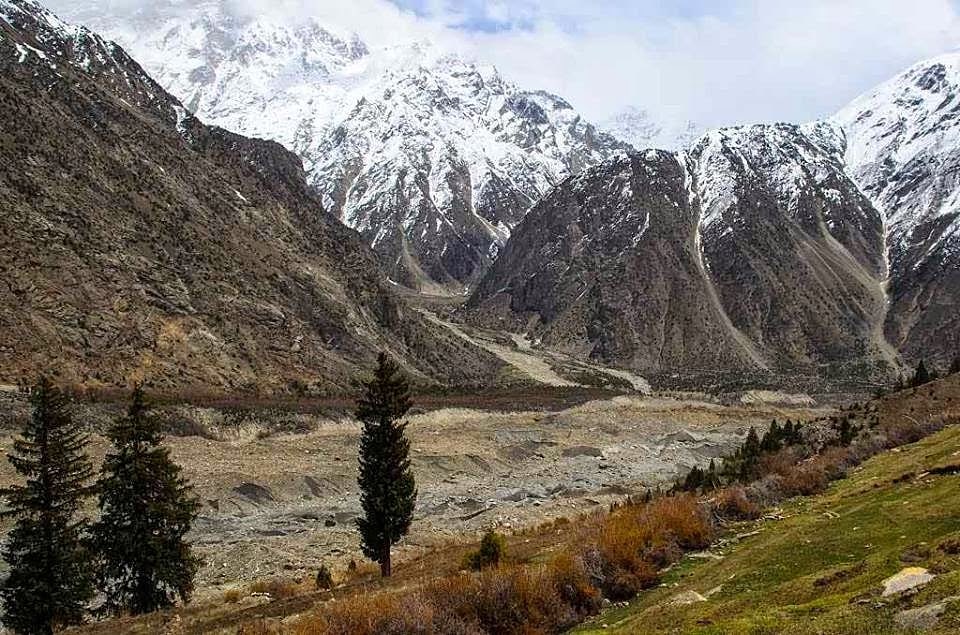
The Kutiah Lungma Glacier is one of the many awe-inspiring natural wonders nestled within Pakistan’s Karakoram Range, a region renowned for its breathtaking landscapes, towering peaks, and vast expanses of ice. Although it may not be as widely recognized as some of the larger glaciers in the area, Kutiah Lungma holds its own unique significance, both in terms of its natural beauty and its contribution to the local environment.
Geographic Location and Features
Kutiah Lungma Glacier is situated in the Haramosh Valley, within the Gilgit-Baltistan region of northern Pakistan. The glacier originates from the Haramosh Peak, which rises to an elevation of 7,409 meters (24,307 feet), making it one of the most formidable mountains in the Karakoram Range. The glacier stretches approximately 12 kilometers (7.5 miles) and flows through a narrow valley, eventually feeding into the Indus River, one of the most important water sources in Pakistan.
The glacier is characterized by its rugged terrain, with steep icefalls, deep crevasses, and towering seracs. It is surrounded by a dramatic landscape of high peaks, including the striking Laila Peak and Mani Peak. The Kutiah Lungma Glacier is less frequented by tourists and mountaineers, which has allowed it to remain relatively undisturbed, preserving its pristine environment.
Historical Significance and Exploration
The Kutiah Lungma Glacier gained prominence in the 1950s when it was the site of one of the fastest glacier surges ever recorded. In 1953, the glacier advanced an astonishing 12 kilometers in just three months, an event that caught the attention of glaciologists and geographers around the world. This rapid movement, known as a glacier surge, is a phenomenon where a glacier can move at rates much faster than usual, often due to a build-up of water pressure beneath the ice.
The 1953 surge of Kutiah Lungma Glacier was one of the earliest well-documented cases of such an event, making it a subject of scientific interest. Researchers have studied the glacier extensively to understand the causes and mechanisms behind these surges, which are still not fully understood. The glacier’s behavior has contributed valuable insights into glaciology and has helped scientists develop models to predict future surges in other glaciers around the world.
Glaciological Importance
Like other glaciers in the Karakoram Range, Kutiah Lungma is a vital source of freshwater for the surrounding regions. The glacier plays a crucial role in feeding the rivers that sustain agriculture, wildlife, and human populations downstream. The meltwater from the glacier contributes to the flow of the Indus River, which is essential for Pakistan’s irrigation systems and hydroelectric power generation.
In recent years, the glacier has been the focus of studies on climate change and its impact on the cryosphere. The Karakoram Range, including the Kutiah Lungma Glacier, has shown a unique pattern of glacial behavior known as the “Karakoram Anomaly.” Unlike many other glacier regions around the world that are experiencing rapid melting due to global warming, some glaciers in the Karakoram are stable or even advancing slightly. This anomaly has intrigued scientists, who are investigating the factors that contribute to this unusual resilience, including regional climate patterns and the complex dynamics of the glaciers themselves.


