Connect with us

Pakistan

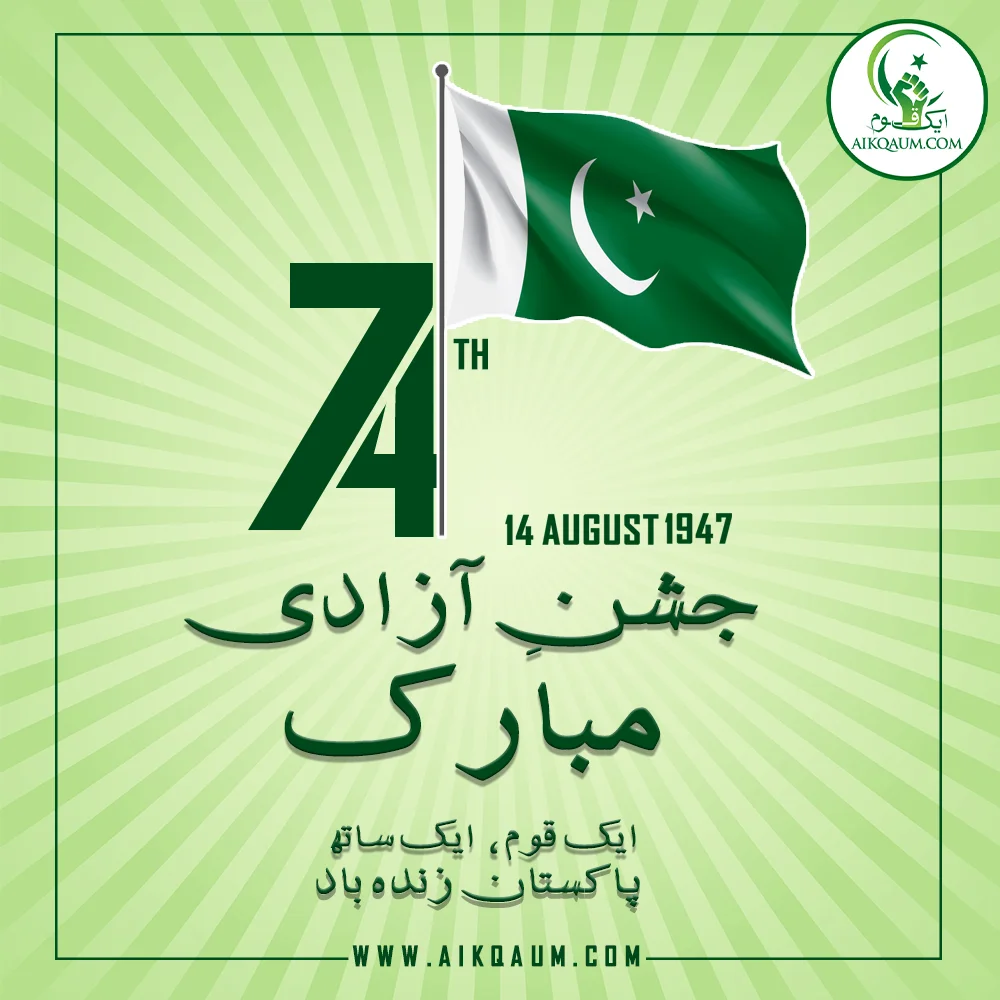
Just turned into the 74th Birth Anniversary

Fariyal Mir

Published

on

Hey, do you know who entered into the 74th birth anniversary? If you don’t then let me tell you it is nobody but Pakistan. Have you ever met with Pakistan which was idealized by Sir Syed Ahmad Khan, formulated by Sir Aga Khan along with many others, dreamed by Allama Iqbal, named by Choudhry Rehmat Ali, founded by Jinnah, defended by “Sher-Bangal” A.K Fazlul Haq stabilized by Liaquat Ali Khan and Khuwaja Nazim Uddin, moralized by Fatima Jinnah? Before answering this question just let me know about yourself. Are you Pakistani I mean do you follow the principles of Jinnah the father of the nation? His principles are Unity, Faith, and Discipline that are the soul of Pakistan. Have you ever observed the flag of Pakistan and the logic behind its color and design? What about your reviews about the national anthem of Pakistan? Have you ever gone through the constitution template of Pakistan?  

I think you are being irritated because of all these questions but the problem is that we cannot meet the actual Pakistan which emerged on the map of the world back on the 14th of August 1947. If you don’t follow the principles of the father of Pakistan then it is not that Pakistan which came into being. If you haven’t observed the design and color of the flag then how would you be able to know that this Pakistan is Islamic but a body for all religious followers? Jinnah had opened it for all as once he said:You are free; you are free to go to your temples, you are free to go to your mosques or any other place or worship in this State of Pakistan. You may belong to any religion or caste or creed – that has nothing to do with the business of the State.”

The national anthem written by Hafiz Jalandary is the core concept of this land Pakistan and if you have just listened to it you can understand it. Pakistan has got a very systematic form of constitution that addresses even minute things. And if you haven’t gone through that and just talking about it from its implementation view then you are mistaken.

There is no one shape of Pakistan despite the boundaries which are separating its edges and that is just a piece of land and body of Pakistan. Then what about the soul of this body? I would like to tell you about the soul of Pakistan. It is you, it is I and it is all the citizens of this land who fulfill the body with life. We are the ones who can make it prosperous and can stand it out in front of the world. Today our father of the nation is not with us but his worthy sayings are always there to guide us. As he had said: “Pakistan not only means freedom and independence but the Muslim Ideology which has to be preserved, which has come to us as a precious gift and treasure and which, we hope others will share with us.”

So let’s do commitment today to be responsible for our country and the Pakistan of Jinnah. It is our 74th anniversary and by entering into our 75th and many more we have to contribute to the progression of our country. And it belongs to our race. Let’s have the notion “Pakistan Banaya Tha Azeem Tar Banayan Ga”. Let’s stand together to prove ourselves as one nation. AikQaum#Aik Sath#Pakistan Zindabad.

Pakistan

Lalak Jan; The living hero of the Kargil war

Fariyal Mir

Published

on

By

Lalak Jan the living hero of this land can never be forgotten. The legend was a Havaldar in the Pakistan Army who was in the Northern Light Infantry regiment during the Kargil battle fought between Pakistan and India from May to July 1999. Lalak Jan lost his temporary life in the war but gained forever life eternally and also in the heart of the people.  And he was awarded Pakistan’s highest rank military award, Nishan-e-Haider. Today on his death anniversary people are paying tributes to him. It has been almost 22 years of his death but he is living in the heart of Pak-army and all the nation. As ISPR has paid homage to Lalak Jan on his great day.

 ISPR stated that:  “Nation pays homage to Havaldar Lalak Jan, NH, who laid his life defending the motherland against (great) odds in most challenging battlefield environment during the Kargil conflict on 7 July 99. His fortitude and selflessness will keep inspiring the indomitable defenders of Pak for times to come.”

Lalak Jan belonged to Gilgit Baltistan but he is the legend of the nation. Indeed Lalak Jan can never be replaced by anyone but there are many Lalak Jan for our piece of land. We are one nation (AikQaum), we are Pakistanis.

Continue Reading

Article

Captain Karnal Sher Khan Shaheed: The Invader

Fariyal Mir

Published

on

Captain Karnal Sher Khan Shaheed had fought no less than an invader during the Kargil war at the Line of Control. He defended five strategic posts and countered the continuous attack by chasing and raids.  

The face of bravery was born on the 1st of January 1970.  He belonged to the land of Swabi in KPK and from there he completed his intermediate from Government Post-Graduate College Swabi and then joined Pakistan Army. He was commissioned in the 27th Sind Regiment on 14 October 1994. Captain Karnal Sher Khan emerged as the symbol of mettle and courage during the Kargil conflict at the Line of Control. He set up personal examples of bravery and inflicted heavy losses on the enemy.

 He defended five strategic posts, which he established with his soldiers at the height of 17,000 feet in the Gultary area. On 5 July 1999, Indians, with the help of two battalions, managed to capture some portion of one of his posts. Despite facing all odds, he led a counter-attack and re-captured the lost portion. Captain Karnal Sher Khan also chased the enemy and conducted many raids in the enemy area. During one such raid, he went inside the enemy camp where he inflicted heavy losses. During the battle, he received a burst of fire in the chest and embraced ‘SHAHADAT’ on 5 July 1999.

He was awarded Nishan-e-Haider for all his bravery. The notion of all martyrs is well described in this verse:

“Ham Haq Par Jan Lutayan Ga Ham Shoq-e-Shahadad Wala Hay

Wo Sath Hamara Tarak Karda Jo Mout Sa Darnay wala Hay.”

Continue Reading

Article

Markhor: The Majestic National Animal of Pakistan

Published

on

By

The Markhor, Pakistan’s national animal, is a symbol of the country’s natural beauty, resilience, and strength. With its striking, spiral horns and graceful stature, the Markhor is one of the most distinctive and remarkable wild goats found in the mountainous regions of northern and western Pakistan. As a creature of both cultural significance and ecological importance, the Markhor represents Pakistan’s commitment to preserving its wildlife and natural heritage.

Physical Characteristics: Nature’s Masterpiece

The Markhor is renowned for its majestic, corkscrew-shaped horns, which can grow up to 1.5 meters (5 feet) in length in males. These horns are its most striking feature and distinguish it from other wild goats. The animal’s name, “Markhor,” is believed to be derived from the Persian words “Mar” (snake) and “Khor” (eater), referring to the belief that the animal has the ability to kill or fight off snakes, though this is more folklore than fact.

Male Markhors are larger than females, and their horns are more prominent and elaborately twisted. They also have a longer coat, especially during the colder months, with a thick beard that gives them a regal appearance. Females, while smaller and with less prominent horns, are equally agile and graceful.

Habitat: Mountainous Majesty

The Markhor thrives in rugged, mountainous terrains at elevations ranging from 600 to 3,600 meters (1,970 to 11,800 feet). It is primarily found in the northern and western regions of Pakistan, particularly in the Himalayas, Hindu Kush, and Karakoram mountain ranges. The provinces of Gilgit-Baltistan, Khyber Pakhtunkhwa, and parts of Balochistan serve as key habitats for these wild goats.

Adapted to the harsh, rocky landscapes of these regions, the Markhor is a skilled climber, able to traverse steep cliffs and narrow ridges with ease. This agility not only helps it evade predators but also aids in foraging for food in difficult terrain.

Conservation Status: A Story of Recovery

The Markhor was once on the brink of extinction, largely due to illegal hunting, habitat loss, and competition with domestic livestock. By the late 20th century, its population had dwindled alarmingly, and the species was classified as endangered by the International Union for Conservation of Nature (IUCN).

In response, the government of Pakistan, along with international conservation organizations, launched several initiatives to protect the Markhor. Strict hunting regulations were imposed, and community-led conservation programs were introduced. These efforts have been remarkably successful, leading to a gradual recovery in the Markhor population. In 2015, the IUCN downgraded the Markhor’s status from “endangered” to “near-threatened,” recognizing the positive impact of conservation efforts.

One of the most successful conservation models has been the community-based trophy hunting program. Local communities are given a quota for limited hunting permits, which are auctioned to international hunters. A significant portion of the revenue generated goes back to the local communities, providing them with a financial incentive to protect the Markhor and its habitat.

Cultural and National Significance

The Markhor holds a special place in the cultural and national identity of Pakistan. As the country’s national animal, it represents the resilience, strength, and beauty of Pakistan’s wilderness and people. Its unique appearance and ability to survive in challenging environments resonate with the values of courage and endurance.

In local folklore, the Markhor is often seen as a creature with mystical powers. The spiral horns are sometimes viewed as a symbol of wisdom and leadership, reflecting the Markhor’s status as the “king” of the mountain goats. Additionally, the animal is associated with bravery and strength, qualities that align with the spirit of Pakistan.

The image of the Markhor is also featured prominently in various emblems and logos throughout Pakistan, including the insignia of the Pakistan Army’s elite Special Services Group (SSG). Its representation in official symbols highlights the national pride and reverence the country has for this majestic animal.

Behavior and Diet: A Survivor of Harsh Environments

Markhors are primarily herbivores, feeding on grasses, leaves, and shrubs, depending on the season. During the summer, they graze on a variety of plants found in the high-altitude meadows. In the winter months, when food is scarce, they move to lower altitudes, foraging for any available vegetation, including leaves, twigs, and bark.

They are social animals, often found in small herds, typically consisting of females and their young. Males tend to be solitary, except during the mating season, when they join the herds to compete for mates. The rutting season, which occurs in the winter, is marked by intense competition among males, with dramatic horn clashes that can last for hours.

Challenges and Future of the Markhor

Despite the success of conservation efforts, the Markhor still faces significant challenges. Habitat loss due to deforestation, expanding agriculture, and infrastructure development continues to threaten the regions where they live. Additionally, climate change poses a long-term risk, potentially altering the ecosystems that support the Markhor.

Continued conservation efforts are crucial to ensuring the long-term survival of the Markhor. Sustainable management of its habitat, strict enforcement of anti-poaching laws, and ongoing community involvement in conservation programs are all vital to maintaining and expanding the Markhor population.

Conclusion: A Symbol of Pakistan’s Natural Heritage

The Markhor is more than just a wild goat; it is a symbol of Pakistan’s natural beauty and the country’s commitment to preserving its unique wildlife. Its recovery from the brink of extinction is a testament to the power of conservation and the importance of protecting the natural world for future generations. As Pakistan’s national animal, the Markhor stands as a proud representation of the country’s strength, resilience, and rich ecological heritage.

To see the Markhor thriving in the mountains of northern Pakistan is to witness nature at its most magnificent—a reminder of the beauty that still exists in our world and the responsibility we all share to protect it.

Continue Reading

Most Popular

English اردو