Pakistan
Botched Indian “Operation Bandar” – 2 IAF aircraft down, 1 pilot captured
Published
5 years agoon
By
Editor

With two aircraft down, one pilot captured alive – “Operation Bandar” – the Balakot strike – failed to achieve not only its objectives but also exposed to the world the inherent weaknesses of a nuclear-armed Inda.
The botched attempt to strike deep inside Pakistan following a false flag operation at Pulwama on Feb 14, 2019, established the military and technological superiority of the Pakistan Air Force and shattered to pieces the myth of Indian military might.
Operation Bandar
The Indian authorities code-named the attack on Balakot as “Operation Bandar” to minimize the chances of leaking the news. The word “Bandar” was chosen because monkeys enjoy a sacred place in the Hindu religion and this refers to a tale in the religious myths of Hinduism where Hanuman – a deity who shows resemblance to the monkey – secretly entered Lanka and burned it to the ground.
Feb 26, 2019 – Balakot Strike
The Indian Air Force launched an aerial strike near ‘Balakot’ On Feb 26, 2019, targeting a religious seminary that India described as a militant camp, and claimed killing more than 300 terrorists but without sharing any shred of evidence to corroborate the claims.
According to Hindustan Times on February 26, 2019 at 3.45am the then Air Chief BS Dhanoa made a telephone call to National Security Adviser Ajit Doval on a secure fixed-line network and said “Bandar mara gaya” – “The monkey has been killed,” but at the end of the day, they just made a monkey of themselves.
INDIAN AIRCRAFTS INTRUDED FROM MUZAFARABAD SECTOR. FACING TIMELY AND EFFECTIVE RESPONSE FROM PAKISTAN AIR FORCE RELEASED PAYLOAD IN HASTE WHILE ESCAPING WHICH FELL NEAR BALAKOT. NO CASUALTIES OR DAMAGE.
— DG ISPR (@OFFICIALDGISPR) FEBRUARY 26, 2019
Following the strike Prime Minister Imran Khan said “India has committed uncalled-for aggression to which Pakistan shall respond at the time and place of its choosing…Armed Forces and the people of Pakistan to remain prepared for all eventualities.”
The Indian strike struck a hillside, killing one crow and damaging few precious pine trees, an act which prompted Prime Minister Imran Khan to repeatedly say that he was very hurt, as trees were very close to his heart.

Military attache’ and foreign media also later visited the site and also went to the nearby madrassa of local village children, who were lucky enough to escape the Indian recklessness.
India claimed that its air force had managed to kill more than 300 terrorists while Pakistan but several international observers negated the claim as there were no casualties and the bombs had clearly missed the target, which in fact was not a terrorist camp, but an ordinary religious school, for the village children.
“The Pakistanis are bound to react, conventionally and not through a proxy like a militant group,” Rahul Bedi, an analyst at the London-based Jane’s Information Group told the New York Times. “Where they react and when is something that only Pakistanis know.”
The newspaper pointed that in the run-up to Indian elections this spring, and with Mr. Modi facing a fierce re-election fight, voters have demanded that New Delhi respond to the Kashmir attack with force against Pakistan.
“What they hit is speculation for now,” Mr. Bedi said. “This is more political symbolism than anything else. Mr. Modi had to show some demonstrable action on India’s part, ahead of elections.”

Feb 27, 2019
In response, Pakistan Air Force launched a counter-strike on Feb 27, 2019, intended primarily to demonstrate Pakistan’s resolve. The strike was carefully crafted to avoid casualties on the ground.
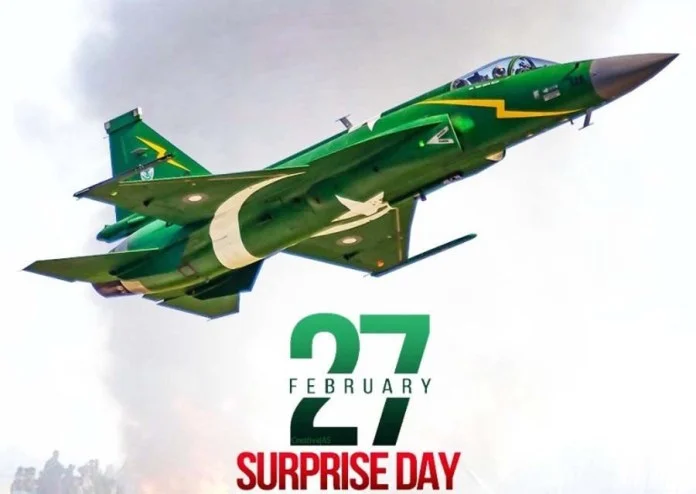
During the short aerial encounter that followed, PAF shot down two IAF aircraft and captured one of the pilots. The success of the Pakistan Air Force in Operation Swift Retort against a far bigger adversary is now observed as a “Surprise Day” every year.
IN RESPONSE TO PAF STRIKES THIS MORNING AS RELEASED BY MOFA, IAF CROSSED LOC. PAF SHOT DOWN TWO INDIAN AIRCRAFTS INSIDE PAKISTANI AIRSPACE. ONE OF THE AIRCRAFT FELL INSIDE AJ&K WHILE OTHER FELL INSIDE IOK. ONE INDIAN PILOT ARRESTED BY TROOPS ON GROUND WHILE TWO IN THE AREA.
— DG ISPR (@OFFICIALDGISPR) FEBRUARY 27, 2019

Wing Commander Abhinandan – File PhotoIndia claimed that one of its Mig-21s shot down Pakistan’s F-16 aircraft which was also refuted by the influential Foreign Policy magazine based on interviews with the US Department of Defence (DoD) officials who verified that no F-16 was missing from the Pakistani inventory.
According to the magazine, Pakistan invited the US to physically count its F-16 planes after the incident as part of an end-user agreement signed when the foreign military sale was finalized.
Some of the aircraft were not immediately available for inspection due to the conflict, so it took US personnel several weeks to account for all of the jets, one US official said.
But now the count has been completed, and “all aircraft were present and accounted for,” the official said.”
While the Indian so-called surgical strike was being touted by India as a great success and declared as a ‘new norm’, but on the other hand, India’s senior leadership blamed the failure on the non-availability of aircraft like Rafale, which according to them would have changed the outcome of Balakot crisis.
Even the Indian Prime Minister Narendra Modi admitted the failure of his Air Force and while speaking at the India Today event said “Today, all of India is saying that if we had the Rafale, then the result would have been different.”
Pakistan’s response was intended to deter war and establish nuclear deterrence, the success of which could be gauged by the fact that India could not move up the escalation ladder and backed down.
#PAKISTANSTRIKESBACK #PAF UNDERTOOK STRIKES ACROSS LOC FROM PAKISTANI AIRSPACE. SOLE PURPOSE OF THIS ACTION WAS TO DEMONSTRATE OUR RIGHT, WILL AND CAPABILITY FOR SELF DEFENCE. WE DO NOT WISH TO ESCALATE BUT ARE FULLY PREPARED IF FORCED INTO THAT PARADIGM#PAKISTANZINDABAD
— SPOKESPERSON 🇵🇰 MOFA (@FOREIGNOFFICEPK) FEBRUARY 27, 2019
On Feb 27, the military’s media wing said Pakistan Air Force had engaged six targets at the LoC. Maj Gen Ghafoor termed it a conscious decision not to attack any military target and avoid any collateral damage. He said one of the targets initially picked was a military administrative complex, however, the PAF command decided against hitting it.
“As a result of engaging our targets, no human life was affected. Staying within our jurisdiction, six targets were locked. And we carried out the strike,” he said.
He said the objective of the strikes was to show “we have the capacity and the will to respond, but we deliberately avoided the escalation path.”
“Pakistan is not pushing for war. We engaged our targets in open air, we deliberately avoided escalation. We could easily have taken the original targets, but we did not do that,” the DG ISPR said.
Feb 28, 2019
A day later Prime Minister Imran Khan in his address to a joint parliamentary session on Feb 28, 2019, said; “In our desire for peace, I announce that tomorrow, and as a first step to open negotiations, Pakistan will be releasing the Indian Air Force officer in our custody.” His decision was hailed by top world leaders as a great peace gesture.
March 1, 2019
Wing Commander Abhinandan was treated well, in line with the Geneva Conventions, provided new dress and of course the famous cup of tea, on which he had remarked: “Tea was Fantastic“. He was handed over to the Indian authorities on March 1, 2019 at the Wagah border.

Pakistan has credible conventional responses designed to meet different contingencies – known as the policy of ‘Quid Pro Quo Plus.’ This has not only reinforced the credibility of Pakistan’s nuclear deterrence but has also helped restore confidence in conventional deterrence.
After experiencing humiliation at the hands of PAF in Feb 2019, India has gone on yet another arms and ammunition shopping spree, without understanding that it is in fact the man behind the machine and the will that matters.
In Laddakh India again suffered humiliation as China established its superiority and controlled the full spectrum of the conflict. The Chinese had calculated the morale and response capability of the Indian military. India stood embarrassed by a smaller force – Pakistan and was left paralyzed by a larger country- China, all within the span of a year.
However, the best sum up came from DG ISPR Major General Babar Iftikhar who while giving a recap of the Feb 2019 events had said;
“WE GAVE THEM A BLOODY NOSE AND IT IS STILL HURTING”
You may like
-
Lalak Jan; The living hero of the Kargil war
-
Captain Karnal Sher Khan Shaheed: The Invader
-
Markhor: The Majestic National Animal of Pakistan
-
Jasmine: The National Flower of Pakistan – A Symbol of Purity, Humility, and Peace
-
Our National Bird Chakor (Partridge) is the sign of Good Luck and symbol of Love
-
Pakistan’s “King of Fruits” — Mango Season Begins
Pakistan
Lalak Jan; The living hero of the Kargil war
Fariyal Mir
Published
2 weeks agoon
July 7, 2026By
Editor
Lalak Jan the living hero of this land can never be forgotten. The legend was a Havaldar in the Pakistan Army who was in the Northern Light Infantry regiment during the Kargil battle fought between Pakistan and India from May to July 1999. Lalak Jan lost his temporary life in the war but gained forever life eternally and also in the heart of the people. And he was awarded Pakistan’s highest rank military award, Nishan-e-Haider. Today on his death anniversary people are paying tributes to him. It has been almost 22 years of his death but he is living in the heart of Pak-army and all the nation. As ISPR has paid homage to Lalak Jan on his great day.
ISPR stated that: “Nation pays homage to Havaldar Lalak Jan, NH, who laid his life defending the motherland against (great) odds in most challenging battlefield environment during the Kargil conflict on 7 July 99. His fortitude and selflessness will keep inspiring the indomitable defenders of Pak for times to come.”
Lalak Jan belonged to Gilgit Baltistan but he is the legend of the nation. Indeed Lalak Jan can never be replaced by anyone but there are many Lalak Jan for our piece of land. We are one nation (AikQaum), we are Pakistanis.
Article
Captain Karnal Sher Khan Shaheed: The Invader
Fariyal Mir
Published
2 weeks agoon
July 5, 2026
Captain Karnal Sher Khan Shaheed had fought no less than an invader during the Kargil war at the Line of Control. He defended five strategic posts and countered the continuous attack by chasing and raids.
The face of bravery was born on the 1st of January 1970. He belonged to the land of Swabi in KPK and from there he completed his intermediate from Government Post-Graduate College Swabi and then joined Pakistan Army. He was commissioned in the 27th Sind Regiment on 14 October 1994. Captain Karnal Sher Khan emerged as the symbol of mettle and courage during the Kargil conflict at the Line of Control. He set up personal examples of bravery and inflicted heavy losses on the enemy.
He defended five strategic posts, which he established with his soldiers at the height of 17,000 feet in the Gultary area. On 5 July 1999, Indians, with the help of two battalions, managed to capture some portion of one of his posts. Despite facing all odds, he led a counter-attack and re-captured the lost portion. Captain Karnal Sher Khan also chased the enemy and conducted many raids in the enemy area. During one such raid, he went inside the enemy camp where he inflicted heavy losses. During the battle, he received a burst of fire in the chest and embraced ‘SHAHADAT’ on 5 July 1999.
He was awarded Nishan-e-Haider for all his bravery. The notion of all martyrs is well described in this verse:
“Ham Haq Par Jan Lutayan Ga Ham Shoq-e-Shahadad Wala Hay
Wo Sath Hamara Tarak Karda Jo Mout Sa Darnay wala Hay.”
Article
Markhor: The Majestic National Animal of Pakistan
Published
3 weeks agoon
June 29, 2026By
EDITOR
The Markhor, Pakistan’s national animal, is a symbol of the country’s natural beauty, resilience, and strength. With its striking, spiral horns and graceful stature, the Markhor is one of the most distinctive and remarkable wild goats found in the mountainous regions of northern and western Pakistan. As a creature of both cultural significance and ecological importance, the Markhor represents Pakistan’s commitment to preserving its wildlife and natural heritage.
Physical Characteristics: Nature’s Masterpiece
The Markhor is renowned for its majestic, corkscrew-shaped horns, which can grow up to 1.5 meters (5 feet) in length in males. These horns are its most striking feature and distinguish it from other wild goats. The animal’s name, “Markhor,” is believed to be derived from the Persian words “Mar” (snake) and “Khor” (eater), referring to the belief that the animal has the ability to kill or fight off snakes, though this is more folklore than fact.
Male Markhors are larger than females, and their horns are more prominent and elaborately twisted. They also have a longer coat, especially during the colder months, with a thick beard that gives them a regal appearance. Females, while smaller and with less prominent horns, are equally agile and graceful.
Habitat: Mountainous Majesty
The Markhor thrives in rugged, mountainous terrains at elevations ranging from 600 to 3,600 meters (1,970 to 11,800 feet). It is primarily found in the northern and western regions of Pakistan, particularly in the Himalayas, Hindu Kush, and Karakoram mountain ranges. The provinces of Gilgit-Baltistan, Khyber Pakhtunkhwa, and parts of Balochistan serve as key habitats for these wild goats.
Adapted to the harsh, rocky landscapes of these regions, the Markhor is a skilled climber, able to traverse steep cliffs and narrow ridges with ease. This agility not only helps it evade predators but also aids in foraging for food in difficult terrain.
Conservation Status: A Story of Recovery
The Markhor was once on the brink of extinction, largely due to illegal hunting, habitat loss, and competition with domestic livestock. By the late 20th century, its population had dwindled alarmingly, and the species was classified as endangered by the International Union for Conservation of Nature (IUCN).
In response, the government of Pakistan, along with international conservation organizations, launched several initiatives to protect the Markhor. Strict hunting regulations were imposed, and community-led conservation programs were introduced. These efforts have been remarkably successful, leading to a gradual recovery in the Markhor population. In 2015, the IUCN downgraded the Markhor’s status from “endangered” to “near-threatened,” recognizing the positive impact of conservation efforts.
One of the most successful conservation models has been the community-based trophy hunting program. Local communities are given a quota for limited hunting permits, which are auctioned to international hunters. A significant portion of the revenue generated goes back to the local communities, providing them with a financial incentive to protect the Markhor and its habitat.
Cultural and National Significance
The Markhor holds a special place in the cultural and national identity of Pakistan. As the country’s national animal, it represents the resilience, strength, and beauty of Pakistan’s wilderness and people. Its unique appearance and ability to survive in challenging environments resonate with the values of courage and endurance.
In local folklore, the Markhor is often seen as a creature with mystical powers. The spiral horns are sometimes viewed as a symbol of wisdom and leadership, reflecting the Markhor’s status as the “king” of the mountain goats. Additionally, the animal is associated with bravery and strength, qualities that align with the spirit of Pakistan.
The image of the Markhor is also featured prominently in various emblems and logos throughout Pakistan, including the insignia of the Pakistan Army’s elite Special Services Group (SSG). Its representation in official symbols highlights the national pride and reverence the country has for this majestic animal.
Behavior and Diet: A Survivor of Harsh Environments
Markhors are primarily herbivores, feeding on grasses, leaves, and shrubs, depending on the season. During the summer, they graze on a variety of plants found in the high-altitude meadows. In the winter months, when food is scarce, they move to lower altitudes, foraging for any available vegetation, including leaves, twigs, and bark.
They are social animals, often found in small herds, typically consisting of females and their young. Males tend to be solitary, except during the mating season, when they join the herds to compete for mates. The rutting season, which occurs in the winter, is marked by intense competition among males, with dramatic horn clashes that can last for hours.
Challenges and Future of the Markhor
Despite the success of conservation efforts, the Markhor still faces significant challenges. Habitat loss due to deforestation, expanding agriculture, and infrastructure development continues to threaten the regions where they live. Additionally, climate change poses a long-term risk, potentially altering the ecosystems that support the Markhor.
Continued conservation efforts are crucial to ensuring the long-term survival of the Markhor. Sustainable management of its habitat, strict enforcement of anti-poaching laws, and ongoing community involvement in conservation programs are all vital to maintaining and expanding the Markhor population.
Conclusion: A Symbol of Pakistan’s Natural Heritage
The Markhor is more than just a wild goat; it is a symbol of Pakistan’s natural beauty and the country’s commitment to preserving its unique wildlife. Its recovery from the brink of extinction is a testament to the power of conservation and the importance of protecting the natural world for future generations. As Pakistan’s national animal, the Markhor stands as a proud representation of the country’s strength, resilience, and rich ecological heritage.
To see the Markhor thriving in the mountains of northern Pakistan is to witness nature at its most magnificent—a reminder of the beauty that still exists in our world and the responsibility we all share to protect it.
Lalak Jan; The living hero of the Kargil war
Captain Karnal Sher Khan Shaheed: The Invader


