Connect with us

Pakistan

AJK President described role of technology as vital to prevent spread of pandemics

Published

on

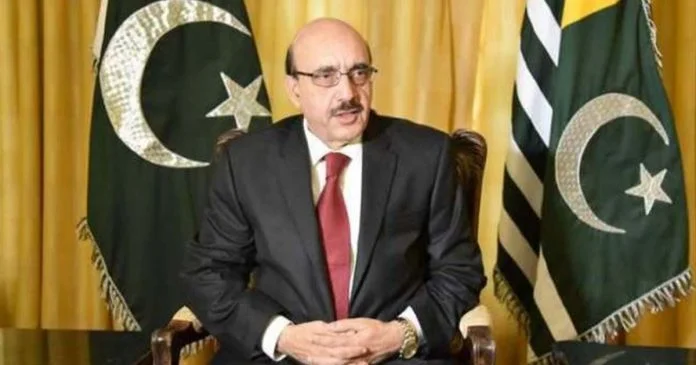
MIRPUR (AJK): May 30 (APP):The AJK President Sardar Masood Khan has said that the importance of new technologies in the fight against the coronavirus pandemic cannot be overlooked as these technologies have huge potential for detection, timely diagnosis, effective treatment, and future prevention of the COVID-19.

Addressing a webinar on “Coronavirus and the role of technologies” organized by the computing and engineering department of the University of Kotli late Saturday, he said that though vaccines and medicines are being used to treat COVID- 19, major reliance has been on prevention, surveillance, and containment of the pandemic, AJK President office told media on Sunday.

Enumerating the technologies being used to curb the viral spread of coronavirus, the State President said that geospatial technology, artificial intelligence (AI), big data, telemedicine, blockchain, 5G technology, smart applications, Internet of Medical Things (IoMT), robotics, and additive manufacturing are substantially important for COVID-19 detection, monitoring, diagnosing, screening, surveillance, mapping, tracking, and creating awareness about the pandemic.

“These technologies have been used on a large scale in the developed world, but unfortunately the developing nations are behind the curve in inducting, absorbing, and mainstreaming these technologies,” he added.

Sardar Masood Khan maintained that the technology cannot prevent the outbreak of pandemics; but it can help prevent the spread, inform, warn, and enable people to respond better and mitigate the impact.

The AJK president said that areas where technologies can help most are contact tracing by data sharing, digital facial recognition, threat assessment, and disease forecasts by using Artificial Intelligence, robots and drones for goods delivery, automatic temperature monitoring, remote working to ensure social distancing, and software to detect Covid through the chest scans.

He said digital technologies are being harnessed to support the public-health response to COVID-19 worldwide, including population surveillance, case identification, contact tracing, and evaluation of interventions on the basis of mobility data and communication with the public.

“These rapid responses leverage billions of mobile phones, large online datasets, connected devices, relatively low-cost computing resources, and advances in machine learning and natural language processing,” he said.

He went on to say that after the outbreak of coronavirus, the AJK government with the help of technologies had established PCR labs and diagnostic centers, upgraded monitoring, and care system in the hospitals, supply of vaccine introduced tele-medicines, and chest scanning.

Similarly, after the closure of educational institutions because of lockdown, a revolution was brought about in the distance education and examination systems with the help of technology.

Continue Reading

Pakistan

Dr. Abdul Qadeer Khan: 90 Years of Legacy, Strength, and National Pride

Published

on

By

Today, April 1, 2026, marks the 90th birth anniversary of Abdul Qadeer Khan — the renowned scientist widely celebrated as the “Father of Pakistan’s Nuclear Program.”

On this day, the nation remembers not just a scientist, but a symbol of determination, resilience, and national sovereignty. His name is deeply etched in the history of Pakistan as the man who transformed the country’s strategic future and strengthened its defense.


Early Life and Education

Dr. Abdul Qadeer Khan was born on April 1, 1936, in Bhopal, then part of British India. After the partition of 1947, his family migrated to Pakistan, where his journey of excellence began.

With a strong passion for science and engineering, he pursued higher education in Europe, specializing in metallurgy and nuclear science. His academic journey equipped him with the expertise that would later change the destiny of Pakistan.


The Defining Mission

The turning point in Dr. Khan’s life came after the 1971 war, which exposed Pakistan’s strategic vulnerabilities. At a time when the nation needed strength and confidence, Dr. Khan stepped forward with a vision.

He returned to Pakistan and joined efforts to develop the country’s nuclear capability. Through his leadership, dedication, and scientific brilliance, Pakistan moved closer to achieving strategic deterrence.


Building a National Capability

Dr. Khan played a central role in establishing the Kahuta Research Laboratories, later named in his honor. His work focused on uranium enrichment, a critical component of nuclear technology.

Despite facing:

  • International pressure
  • Limited resources
  • Technological challenges

He and his team worked tirelessly, driven by a single goal: to ensure Pakistan’s security and independence.


A Historic Milestone

On May 28, 1998, Pakistan conducted its nuclear tests, becoming the first Muslim nuclear power and the seventh nuclear state in the world.

This historic achievement marked a defining moment in Pakistan’s history. It was seen as a demonstration of national strength and scientific capability, and Dr. Abdul Qadeer Khan became a national hero.


A Complex but Powerful Legacy

Dr. Khan’s life was not without controversy. His later years were marked by international scrutiny and political challenges. However, within Pakistan, he remained a deeply respected figure.

For millions, he symbolized:

  • National dignity
  • Scientific achievement
  • Strategic independence

His contributions sparked important discussions about science, ethics, and national security.


A Human Story Behind the Scientist

Beyond his scientific achievements, Dr. Khan was known for his simplicity and connection with the people. He often spoke about education, self-reliance, and national pride.

He believed that the true strength of a nation lies not only in its defense but in the character and unity of its people.


Lessons for the Future

On his 90th birth anniversary, Dr. Abdul Qadeer Khan’s life offers powerful lessons:

  • Vision can change destiny
  • Knowledge is power
  • Nations rise when their people believe in themselves

For the youth of Pakistan, his journey is a reminder that dedication and purpose can shape history.

Continue Reading

Pakistan

Nation celebrates Pakistan Day today

Published

on

By

Pakistan Day is being celebrated with great enthusiasm and national unity across the country today.

The nation is renewing its resolve today to demonstrate more hard work, unity and sacrifice for the development, stability and prosperity of Pakistan.

The day dawned with thirty-one-gun salute in the federal capital and twenty-one-gun salute in provincial capitals.

These salutes were given as a symbol of national dignity, sovereignty and the professional capabilities of the Pakistan’s armed forces.

After Fajr prayer, special prayers were offered for the security, development, prosperity and national unity of the country as well as for the elevation of the ranks of the martyrs.

The national flag was hoisted on important government buildings, which is a symbol of national dignity and cohesion.

On the occasion of Pakistan Day, the entire nation is united and adorned with the noble resolve to work together for the progress and prosperity of the country.

Continue Reading

Pakistan

MOTTO:- Iman, Taqwa, Jihad-fi-Sabilillah.

Published

on

By

AikQaum Identity Caption

“AikQaum stands on three timeless principles: Iman (Faith), Taqwa (Integrity), and Jihad-fi-Sabilillah (Striving in the path of Allah).

Iman: To have faith and trust in Allah and consider oneself a follower of none but Allah, and a follower of none but his messenger.
Taqwa: The fear of Allah. Guarding ones tongue, hands and heart from evil. Righteous, piety and good conduct.
Jihad-fi-Sabilillah: The real objective of Islam is to shift the lordship of man over man to the lordship of Allah on the earth and to stake one’s life and everything else to achieve this sacred purpose.

Source:- https://ispr.gov.pk/

Continue Reading

Most Popular

English اردو