ISLAMABAD, Aug 16 (APP): Prime Minister Imran Khan on Monday said the Single National Curriculum (SNC) would prove an important milestone in transforming the nation into a “unified entity, rooted in common morals and ethos”.
“A uniform curriculum will guide the nation in one direction and converge the diversified energies in achieving the common goals of progress,” the prime minister said at the launch of the first phase of SNC, here at the PM House.
Prime Minister Imran Khan addressing at the launching ceremony of Single National Curriculum. APP
The prime minister formally launched the online portal with the uniform syllabus, which has been developed by the National Curriculum Council, Ministry of Federal Education and Professional Training in consultation and collaboration with education departments of all federating units of the country.
Prime Minister Imran Khan launches Single National Curriculum. APP
Under the first phase, the Single National Curriculum has been implemented for grades pre-1 to 5 starting the current academic year, whereas in second and third phases, the grades 6 to 8 (2022-23) and grades 9 to 12 (2023-24) will follow the new curriculum, respectively.
The prime minister said the launch of SNC was the fulfillment of his 25-year-old dream to end educational disparity among different sections of society.
He regretted that the difference of Urdu and English-medium schooling resulted in creating a wide gulf among different social classes with the ills of intellectual inferiority or superiority complexes. English, he said, did not remain limited to a language to learn knowledge, but became a status symbol.
“Breaking the shackles of minds is more difficult and we are determined to bring the nation out of such complexes,” he said, stressing that no nation could rise until it relied on its original values and morals.
He expressed satisfaction that in the new curriculum, special emphasis had been laid on the teachings of Holy Prophet Muhammad (Peace be upon Him) as an inspiration of ethics and morality. He mentioned that the minorities would also be taught about their religions.
The lauded the strenuous hardwork of Education Minister Shafqat Mahmood and his team in materializing the vision of a single national curriculum. However, he directed to reduce the timeframe for implementation of second and third phases and make efforts to get them implemented in six months.
Education Minister Shafqat Mahmood said for the first time in the country’s history, the national curriculum had been launched in Punjab, Khyber Pukhtunkhwa, Balochistan, Gilgit Baltistan and Azad Jammu and Kashmir. He said consultations would be made with the Sindh government as well for its implementation.
He said several developed countries including the United Kingdom, China, Germany and Japan followed their own national curriculum, adding that a uniform framework would help the Pakistani students a level-playing field in academics.
Director National Curriculum Council Dr Mariam Chughtai said the new syllabus would act as a ‘living document’ with always room for improvement and would be made accessible for all students across the country through technology.
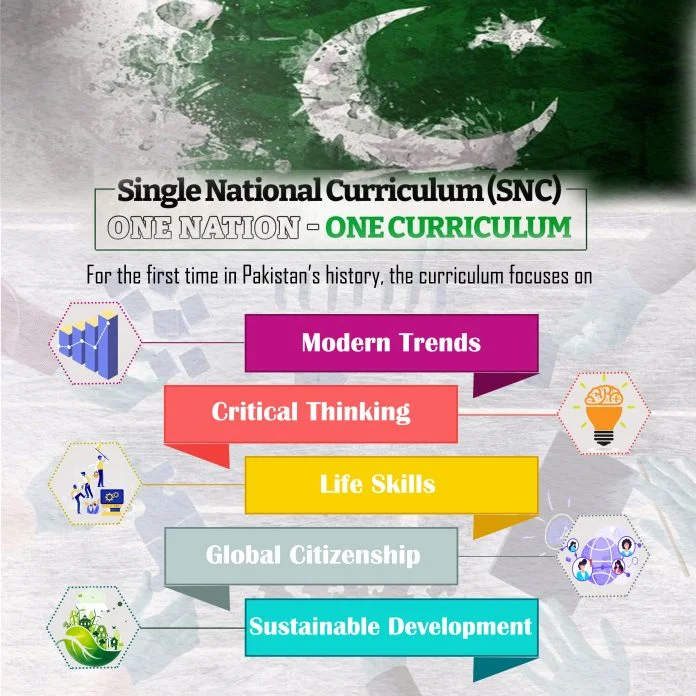
The SN will focus on Pakistan’s constitutional framework, national policies with their aspirations and standards, alignment with Sustainable Development Goals, the Quaid and Iqbal’s vision, a focus on values, respect for diversity in cultures and religions, and the development of 21st century skills including analytical, critical, and creative thinking.
The process for developing the SNC entailed both a comparative review with curricula from other countries and consensus building within Pakistan following a consultative process.
As a first step, multiple comparative studies were conducted to align an SNC draft with international standards. These standards were taken from curricula followed in Singapore, United Kingdom, Malaysia and Indonesia, and findings incorporated in the SNC draft.
A consultative process with stakeholders across Pakistan followed, including representation from the public sector, private sector, madaris, and the cantonment and Garrison boards.
The provincial and area workshops were subsequently held in all federating units. Finally, a National Conference was held in Islamabad where consensus on the final draft of the curriculum was secured.
The model textbooks based on the SNC besides the teacher training modules have also been developed for grades Pre-1 to 5. These have been shared with all federating units to support timely implementation of the SNC on the ground.
Under SNC, English will be taught as a language with a focus on skills. In Islamiat, new themes of “Muamilaat” and “Islam aur daur e Hazir ke Taqazay” have been added.
The experts from all factions of Ittehad Tanzimat Ul Madaris Pakistan were part of the consultation. To ensure intra-faith harmony, the SNC focuses on what is common between schools of thought and avoids promoting religious differences.
The practical aspects of Seerat as the blessed life of Prophet Muhammad (PBUH) have a special focus in the SNC, particularly in terms of how they apply to the lives of our young generation. These include taking care of the planet, water conservation, rights of elderly, citizenship, respect for religious and cultural diversity, and values of honesty and hard work.
For students from minority faiths, a separate curriculum with the title Religious Education has been developed. Five major religions are represented, with individual curriculum for each including Christianity, Hinduism, Sikhism, Baha’i and Kalash.
Social Studies has been developed to encourage patriotism, global citizenship, human rights and peace.
Reading is the strategy to relieve you from conflicts and libraries are the guardhouses for reading. It is the best policy that can lead you everywhere. One can easily move to the history of many centuries ago and can visualize the exact scenario. It takes to the trip of imagination and far beyond. Reading allows meeting with imaginative characters. They are able to talk and walk with the products of imagination. It has the strongest power to strengthen your opinion. I would like to quote George R.R Martin who says that: “A reader lives a thousand lives before he dies.”
Moreover, reading introduces you to an unknown world where you can find the flavor of your life. It is the best friend of escapism. Reading books bless you with the treasure of knowledge. Garrison Keillor well said about the book: “A book is a gift you can open again and again.” Reading is a culture and it has led developed countries towards their developments. So why not develop this culture among the people.
Hence, to develop this culture there must a range of libraries. Libraries are the places that can motivate people toward reading culture. Building libraries do not charge that much amount but become the liveliest buildings. Such buildings are museums in themselves and engage people from reality to imagination. The walls decorated with books give the feeling of excitement and curiosity. Because once you become habitual of reading you can leave the world but not your reading habit.
Moreover, reading lets you put your feet in someone else shoes and walk on their behalf. It makes you like to feel things, to learn more, and to grasp a lot of experiences. In this way, it teaches you things before time. Foremost, it allows you to explore the world. Empower you to conquer the world through your imagination. Arouses your emotion and makes you a human being.
Every society, community, and family needs a building of books. There must be at one public library if not more than that so that the people can make their mind towards reading culture. A proper library setup can persuade most people toward reading culture. I grantee you when the people are engrossed into reading culture then there is no power to distract them. And every household will furnish their one wall for books. That would be amazing.
The well-known Muslim scientist Abū al-Qāsim al-Zahrāwī, also spelled Abul Kasim, in full Abū al-Qāsim Khalaf ibn ʿAbbās al-Zahrāwī, Latin Albucasis, was born in 936, near Córdoba Spain. He had his origin from the Medinan tribe of Al-Ansar. He lived most of his life in Cordoba. It is also where he studied, taught, and practiced medicine and surgery. He was a medieval surgeon of Andalusian Spain, whose comprehensive medical text, combining Middle Eastern and Greco-Roman classical teachings, shaped European surgical procedures until the Renaissance.
The Surgical Man
Al-Zahrawi remained the greatest surgical man. He specialized in curing disease by cauterization. And invented several devices used during surgery, for purposes such as inspection of the interior of the urethra. He also used surgical devices in applying and removing foreign bodies from the throat, the ear, and other body organs. The man of cure is ranked as the first to illustrate the various cannulae and the first to treat a wart with an iron tube and caustic metal as a boring instrument. He had performed laryngotomy on a slave girl without any experience but became successful and called it not dangerous.
Moreover, Al-Zahrawi is also considered to be pioneered neurosurgery and neurological diagnosis. He is known to have performed surgical treatments of head injuries, skull fractures, spinal injuries, hydrocephalus, subdural effusions, and headache. Al-Zahrawi had given the first clinical description of an operative procedure for hydrocephalus. And clearly described the evacuation of superficial intracranial fluid in hydrocephalic children. Other than this he had written a complete code of surgical conduct that is used by modern surgeons. He had made many surgical tools that became the base for the development of advanced tools.
His Book Kitab al-Tasrif
Al-Zahrawi’s Kitab al-Tasrif is a medical encyclopedia comprised of thirty volumes that he completed in the year 1000. It covered a broad range of medical topics, including surgery, medicine, orthopedics, ophthalmology, pharmacology, nutrition, dentistry, childbirth, and pathology. The first volume in the encyclopedia is concerned with general principles of medicine, the second with pathology, while much of the rest discuss topics regarding pharmacology and drugs. The last treatise and the most celebrated one is about surgery. Al-Zahrawi stated that he chose to discuss the surgery in the last volume because surgery is the highest form of medicine, and one must not practice it until he becomes well-acquainted with all other branches of medicine.
The work contained data that had accumulated during a career that spanned almost 50 years of training, teaching, and practice. In it, he also wrote of the importance of a positive doctor-patient relationship and wrote affectionately of his students, whom he referred to as “my children”. He also emphasized the importance of treating patients irrespective of their social status. He encouraged the close observation of individual cases in order to make the most accurate diagnosis and the best possible treatment.
The wise surgeon once said about anatomy: “Before practicing surgery one should gain knowledge of anatomy and the function of organs so that he will understand their shape, connections, and borders. He should become thoroughly familiar with nerves muscles bones arteries and veins. If one does not comprehend anatomy and physiology one can commit a mistake that will result in the death of the patient. I have seen someone incise into a swelling in the neck thinking it was an abscess when it was an aneurysm and the patient dying on the spot.”
In short, he had given complete documentation and procedure along with a description. He has made the world of surgery.