Pakistan
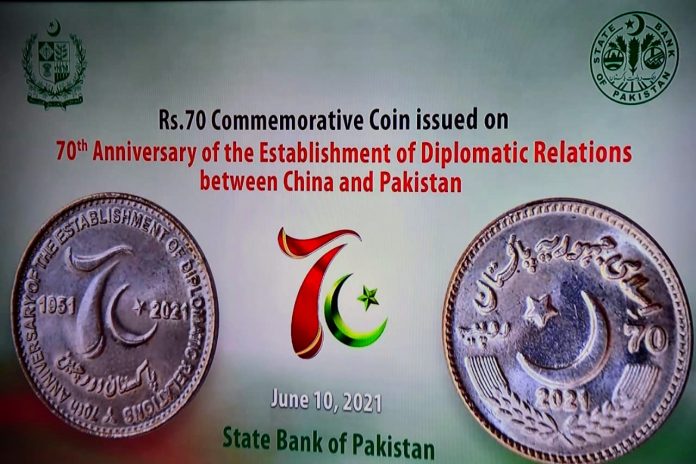
Rs 70 commemorative coin issued on 70th anniversary of Pak-China ties
Published
5 years agoon
By
Editor
ISLAMABAD, June 10 (APP): Foreign Minister Shah Mahmood Qureshi on Thursday said the time-tested relationship of Pakistan and China was flourishing with each passing day, unaffected by the vicissitudes of time and changes in the regional and global environment.
In his address at the issuance of commemorative coin in connection with celebrations marking 70 years of establishment of Pak-China diplomatic relations, the foreign minister said unrelenting efforts of the successive generations of people and the leadership of Pakistan and China had transformed the relationship into an ‘All-Weather Strategic Cooperative Partnership.’
The coin’s denomination has been kept at Rs 70, depicting the 70 years of all-weather, time-tested and brotherly relationship between Pakistan and China.
Governor State Bank of Pakistan Dr. Reza Baqir, China’s Ambassador Nong Rong and senior officials attended the ceremony.
The foreign minister said the relationship of Pakistan and China was unique in the world with the historic ties stretching over the span of millennia.
“Historically, academics, monks, travellers and traders frequently traversed the stretches of Trans-Karakorum tracts and laid the foundation of this fraternal bond,” he said.
Qureshi said Pakistan and China steadfastly supported each other on the issues of core interest.
He mentioned that Pakistan adhered to ‘One-China’ policy and supported China on issues such as Xinjiang, Hong Kong, South China Sea, Taiwan and Tibet.
He said China stood by Pakistan in supporting the key strategic, economic and developmental priorities.
“Maintaining its principled stance, China has unwaveringly supported Pakistan on the Jammu & Kashmir dispute,” he said.

On China-Pakistan Economic Corridor (CPEC), the foreign minister said the venture brought this relationship to new heights.
After the successful conclusion of its first phase, he said, CPEC had entered into second phase with focus on industrial cooperation, trade, agriculture and socio-economic development. Ground-breaking of Rashakai Special Economic Zone last month has the potential to spur industrialization and enhance our exportable surplus, he added.
The foreign minister said in the wake of emerging global and regional environment, Pakistan has recalibrated its priorities from geo-politics to geo-economics.
“China-Pakistan Economic Corridor (CPEC), being the flagship project of the Belt and Road Initiative (BRI), complements Pakistan’s renewed efforts of geo-economic shift with emphasis on economic integration and regional connectivity,” he said.
He said for generations, Pakistan and China had had the fine tradition of standing by each other through thick and thin.
After the outbreak of COVID-19 in China and Pakistan, both countries extended material and moral support to each other in their respective efforts to contain the pandemic, he added.
On vaccine, he said the cooperation was also progressing very well as China gifted millions of doses of COVID-19 vaccine to Pakistan. Pakistan is also procuring Chinese vaccine on commercial basis, he added.
“We remain grateful to the Chinese government and people for their steadfast support, which has been instrumental in saving precious lives in Pakistan,” he said.
Qureshi said Pakistan had robust engagement with China in economic and financial sectors. Second phase of China-Pakistan Free Trade Agreement (CPFTA), signed during the Prime Minister’s visit to Beijing in 2019, has been operationalized since 1st January 2020, he added.
He said the second phase of FTA had the potential to enhance Pakistan’s exports to China.
To facilitate financial transactions and arrangements, the he said, Pakistan also had Currency Swap Agreement with China.
He said both countries had robust cooperation in banking sectors as well besides Pakistani commercial banks had started operations in China. The State Bank of Pakistan, he said, as the regulator of the monetary and credit system of Pakistan, had a pivotal role in further deepening this relationship.
Governor SBP Dr. Reza Baqir said it was an honor for State Bank of Pakistan to be part of the tribute being paid by the government of Pakistan by issuing this commemorative coin to celebrate the diplomatic relationship of the two countries.
He said this was the fourth time SBP had issued a commemorative coin relating to Pak-China relations and recalled that earlier coins were issued on founding anniversary of People’s Republic of China, establishment of diplomatic relations between the two countries and on the occasion to mark Pakistan-China Year of Friendship.
Chinese ambassador Nong Rong said both the government and people of China loved their Pakistani brethren and desired to see the country making progress in every sphere of life.
He said both China and Pakistan shared same views on all-important international issues.
The coin shall be issued through the exchange counters of SBP Banking Services Corporation from June 11, 2021. The coin is in round shape milled with serrations on the edge, diameter of 30.00 mm, weight 13 grams and has Cupro-Nickel metal contents (Copper 75% & Nickel 25%).
| OBVERSE:The waxing crescent moon and five-pointed star facing North West in rising position is in the center on the obverse side of the coin. Along with periphery on the top of the crescent star is inscribed in the wording “ISLAMI JAMHORIA PAKISTAN” in Urdu script. Below the crescent and at the top of two springs of wheat with arms curved upward, there is the year of issuance 2021. The face value of the coin in numerical “70” in bold letters and RUPIA in Urdu script are written on the right and left sides of the crescent star respectively. | |
| REVERSE:On the reverse side of the coin, the logo is shown in the Center. The wording “70th ANNIVERSARY OF THE ESTABLISHMENT OF DIPLOMATIC RELATIONS” is written all along the periphery and “Pakistan Aur China” is written in Urdu script at the bottom of the logo. The years “1951 TO 2021” are depicted at the left and right side of the logo indicating the span of seventy years of diplomatic relations. |
The first coin of Rs.10 denomination was issued in October 2009 celebrating the auspicious occasion of 60th Anniversary of founding of Peoples Republic of China. The second coin of Rs.20 was issued in May 2011 to celebrate 60th Anniversary of establishment of diplomatic relations between Pakistan and China as Year of Pak-China Friendship – 2011. The third coin was issued in 2015 to mark Pakistan-China Year of Friendly Exchange 2015.
You may like
-
Lalak Jan; The living hero of the Kargil war
-
Captain Karnal Sher Khan Shaheed: The Invader
-
Markhor: The Majestic National Animal of Pakistan
-
Jasmine: The National Flower of Pakistan – A Symbol of Purity, Humility, and Peace
-
Our National Bird Chakor (Partridge) is the sign of Good Luck and symbol of Love
-
Pakistan’s “King of Fruits” — Mango Season Begins
Pakistan
Lalak Jan; The living hero of the Kargil war
Fariyal Mir
Published
2 weeks agoon
July 7, 2026By
Editor
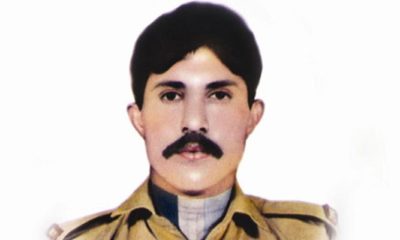
Lalak Jan the living hero of this land can never be forgotten. The legend was a Havaldar in the Pakistan Army who was in the Northern Light Infantry regiment during the Kargil battle fought between Pakistan and India from May to July 1999. Lalak Jan lost his temporary life in the war but gained forever life eternally and also in the heart of the people. And he was awarded Pakistan’s highest rank military award, Nishan-e-Haider. Today on his death anniversary people are paying tributes to him. It has been almost 22 years of his death but he is living in the heart of Pak-army and all the nation. As ISPR has paid homage to Lalak Jan on his great day.
ISPR stated that: “Nation pays homage to Havaldar Lalak Jan, NH, who laid his life defending the motherland against (great) odds in most challenging battlefield environment during the Kargil conflict on 7 July 99. His fortitude and selflessness will keep inspiring the indomitable defenders of Pak for times to come.”
Lalak Jan belonged to Gilgit Baltistan but he is the legend of the nation. Indeed Lalak Jan can never be replaced by anyone but there are many Lalak Jan for our piece of land. We are one nation (AikQaum), we are Pakistanis.
Article
Captain Karnal Sher Khan Shaheed: The Invader
Fariyal Mir
Published
2 weeks agoon
July 5, 2026
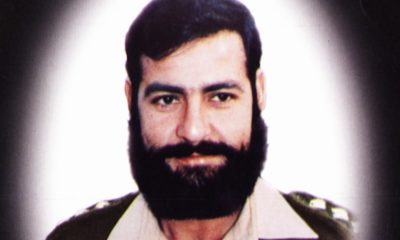
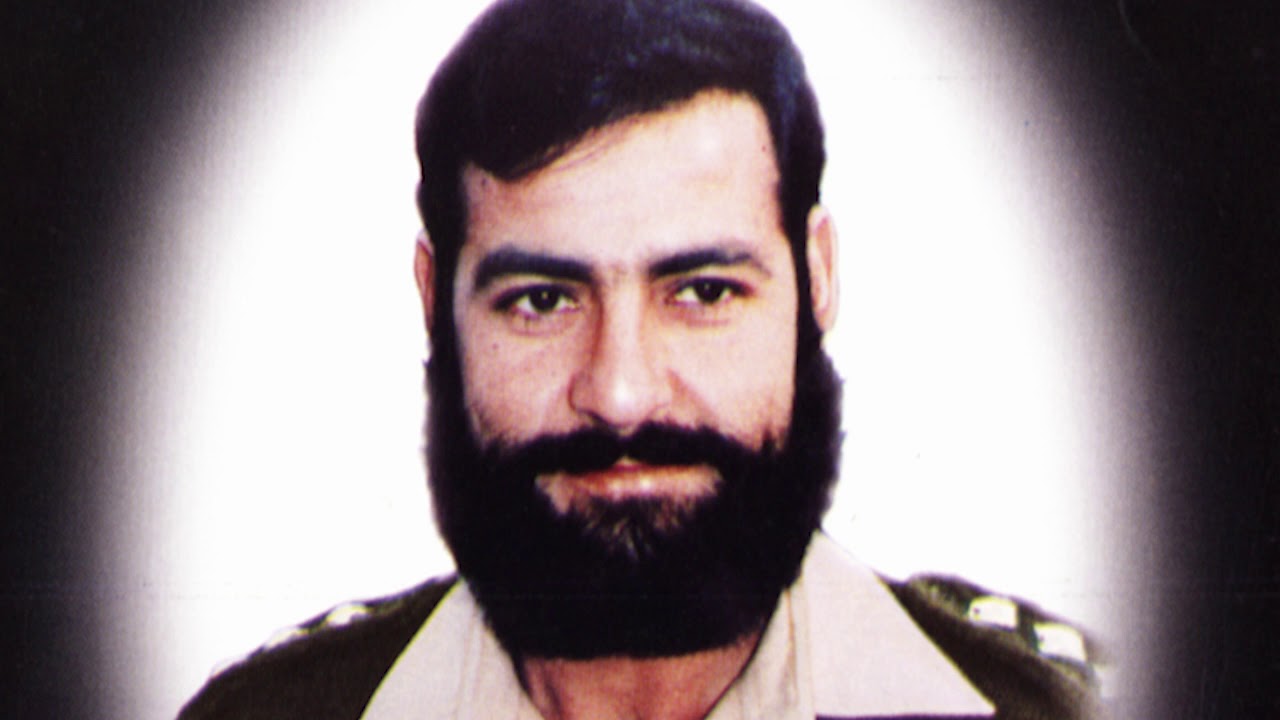
Captain Karnal Sher Khan Shaheed had fought no less than an invader during the Kargil war at the Line of Control. He defended five strategic posts and countered the continuous attack by chasing and raids.
The face of bravery was born on the 1st of January 1970. He belonged to the land of Swabi in KPK and from there he completed his intermediate from Government Post-Graduate College Swabi and then joined Pakistan Army. He was commissioned in the 27th Sind Regiment on 14 October 1994. Captain Karnal Sher Khan emerged as the symbol of mettle and courage during the Kargil conflict at the Line of Control. He set up personal examples of bravery and inflicted heavy losses on the enemy.
He defended five strategic posts, which he established with his soldiers at the height of 17,000 feet in the Gultary area. On 5 July 1999, Indians, with the help of two battalions, managed to capture some portion of one of his posts. Despite facing all odds, he led a counter-attack and re-captured the lost portion. Captain Karnal Sher Khan also chased the enemy and conducted many raids in the enemy area. During one such raid, he went inside the enemy camp where he inflicted heavy losses. During the battle, he received a burst of fire in the chest and embraced ‘SHAHADAT’ on 5 July 1999.
He was awarded Nishan-e-Haider for all his bravery. The notion of all martyrs is well described in this verse:
“Ham Haq Par Jan Lutayan Ga Ham Shoq-e-Shahadad Wala Hay
Wo Sath Hamara Tarak Karda Jo Mout Sa Darnay wala Hay.”
Article
Markhor: The Majestic National Animal of Pakistan
Published
3 weeks agoon
June 29, 2026By
EDITOR
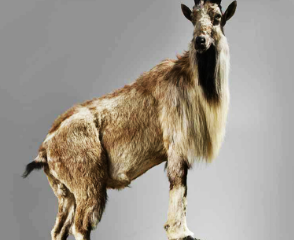
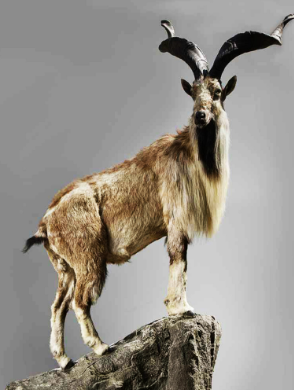
The Markhor, Pakistan’s national animal, is a symbol of the country’s natural beauty, resilience, and strength. With its striking, spiral horns and graceful stature, the Markhor is one of the most distinctive and remarkable wild goats found in the mountainous regions of northern and western Pakistan. As a creature of both cultural significance and ecological importance, the Markhor represents Pakistan’s commitment to preserving its wildlife and natural heritage.
Physical Characteristics: Nature’s Masterpiece
The Markhor is renowned for its majestic, corkscrew-shaped horns, which can grow up to 1.5 meters (5 feet) in length in males. These horns are its most striking feature and distinguish it from other wild goats. The animal’s name, “Markhor,” is believed to be derived from the Persian words “Mar” (snake) and “Khor” (eater), referring to the belief that the animal has the ability to kill or fight off snakes, though this is more folklore than fact.
Male Markhors are larger than females, and their horns are more prominent and elaborately twisted. They also have a longer coat, especially during the colder months, with a thick beard that gives them a regal appearance. Females, while smaller and with less prominent horns, are equally agile and graceful.
Habitat: Mountainous Majesty
The Markhor thrives in rugged, mountainous terrains at elevations ranging from 600 to 3,600 meters (1,970 to 11,800 feet). It is primarily found in the northern and western regions of Pakistan, particularly in the Himalayas, Hindu Kush, and Karakoram mountain ranges. The provinces of Gilgit-Baltistan, Khyber Pakhtunkhwa, and parts of Balochistan serve as key habitats for these wild goats.
Adapted to the harsh, rocky landscapes of these regions, the Markhor is a skilled climber, able to traverse steep cliffs and narrow ridges with ease. This agility not only helps it evade predators but also aids in foraging for food in difficult terrain.
Conservation Status: A Story of Recovery
The Markhor was once on the brink of extinction, largely due to illegal hunting, habitat loss, and competition with domestic livestock. By the late 20th century, its population had dwindled alarmingly, and the species was classified as endangered by the International Union for Conservation of Nature (IUCN).
In response, the government of Pakistan, along with international conservation organizations, launched several initiatives to protect the Markhor. Strict hunting regulations were imposed, and community-led conservation programs were introduced. These efforts have been remarkably successful, leading to a gradual recovery in the Markhor population. In 2015, the IUCN downgraded the Markhor’s status from “endangered” to “near-threatened,” recognizing the positive impact of conservation efforts.
One of the most successful conservation models has been the community-based trophy hunting program. Local communities are given a quota for limited hunting permits, which are auctioned to international hunters. A significant portion of the revenue generated goes back to the local communities, providing them with a financial incentive to protect the Markhor and its habitat.
Cultural and National Significance
The Markhor holds a special place in the cultural and national identity of Pakistan. As the country’s national animal, it represents the resilience, strength, and beauty of Pakistan’s wilderness and people. Its unique appearance and ability to survive in challenging environments resonate with the values of courage and endurance.
In local folklore, the Markhor is often seen as a creature with mystical powers. The spiral horns are sometimes viewed as a symbol of wisdom and leadership, reflecting the Markhor’s status as the “king” of the mountain goats. Additionally, the animal is associated with bravery and strength, qualities that align with the spirit of Pakistan.
The image of the Markhor is also featured prominently in various emblems and logos throughout Pakistan, including the insignia of the Pakistan Army’s elite Special Services Group (SSG). Its representation in official symbols highlights the national pride and reverence the country has for this majestic animal.
Behavior and Diet: A Survivor of Harsh Environments
Markhors are primarily herbivores, feeding on grasses, leaves, and shrubs, depending on the season. During the summer, they graze on a variety of plants found in the high-altitude meadows. In the winter months, when food is scarce, they move to lower altitudes, foraging for any available vegetation, including leaves, twigs, and bark.
They are social animals, often found in small herds, typically consisting of females and their young. Males tend to be solitary, except during the mating season, when they join the herds to compete for mates. The rutting season, which occurs in the winter, is marked by intense competition among males, with dramatic horn clashes that can last for hours.
Challenges and Future of the Markhor
Despite the success of conservation efforts, the Markhor still faces significant challenges. Habitat loss due to deforestation, expanding agriculture, and infrastructure development continues to threaten the regions where they live. Additionally, climate change poses a long-term risk, potentially altering the ecosystems that support the Markhor.
Continued conservation efforts are crucial to ensuring the long-term survival of the Markhor. Sustainable management of its habitat, strict enforcement of anti-poaching laws, and ongoing community involvement in conservation programs are all vital to maintaining and expanding the Markhor population.
Conclusion: A Symbol of Pakistan’s Natural Heritage
The Markhor is more than just a wild goat; it is a symbol of Pakistan’s natural beauty and the country’s commitment to preserving its unique wildlife. Its recovery from the brink of extinction is a testament to the power of conservation and the importance of protecting the natural world for future generations. As Pakistan’s national animal, the Markhor stands as a proud representation of the country’s strength, resilience, and rich ecological heritage.
To see the Markhor thriving in the mountains of northern Pakistan is to witness nature at its most magnificent—a reminder of the beauty that still exists in our world and the responsibility we all share to protect it.
Lalak Jan; The living hero of the Kargil war
Captain Karnal Sher Khan Shaheed: The Invader