


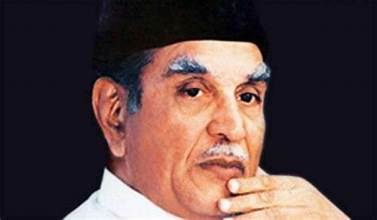
Hakim Muhammad Saeed January 1920 – 17 October 1998, NI, PhD) was a medical researcher, scholar, philanthropist, and a Governor of Sindh Province, Pakistan from 1993 until 1996. Saeed was one of Pakistan’s most prominent medical researchers in the field of Eastern medicines. He established the Hamdard Foundation in 1948, prior to his settlement in West Pakistan. In a few years time, the herbal medical products of the Hamdard Foundation became household names in Pakistan. Hakim Muhammad Saeed authored and compiled about 200 books in medicines, philosophy, science, health, religion, natural medicine, literary, social, and travelogues. On 17 October 1998, Saeed was assassinated by a group of unknown assailants while he was on his way to attend a medical experiment at the Hamdard Laboratories.
Youth
Hakim Muhammad Saeed was born in New Delhi, British Indian Empire in 1920 to an educated and religious Urdu-speaking class.His forefathers and family had been associated with the herbal medicine business, and had established the Hamdard Waqf Laboratories which today has emerged as one of the largest manufacturers of Unani medicines in the world. Saeed attended the local school where he learned Arabic, Persian, Urdu, English and studied the Quran. At age 18, Hakim passed the university entrance test and went on to attend the University of Delhi in 1938. There, Saeed obtained a BPharm and BS in medicinal chemistry in 1942.
After his undergraduate education, Saeed joined Hamdard Waqf Laboratories as a junior researcher and participated in herbal quality control while formulating medicines. In 1945, Saeed attended the post-graduate course, and obtained MPharm in Pharmacy from the same institution. After the independence of Pakistan in 1947, Saeed left his hometown with his wife and daughter. The family settled in Karachi, Sindh Province of West Pakistan. He established Hamdard Laboratories and served as its first director until his death in 1998. In 1952, Saeed travelled to Turkey where he attended the Ankara University and was awarded a PhD in Pharmacy, then returned to Pakistan to devote his life to medicine research.
Scholarship
Following his settlement in Pakistan, Saeed began practising medicine and continued to research Eastern medicines.Having established the Hamdard Laboratories in 1948, Saeed was one the driving force in Pakistan for engaging the research in medical biology and medicines. In 1953, after his doctorate,Saeed joined the Sindh University as the associate professor of Pharmacy and taught courses in organic chemistry. In 1963, Saeed resigned from his position due to amid differences with the Federal government. In 1964, Saeed came into public limelight when he gave rogue criticism to Lieutenant-General Vajid Burkie, then-Surgeon General of Army Medical Corps and then high profile officer leading the Ministry of Health under the government of Field Marshal Ayub Khan. Saeed criticised the General, saying, “General [Vajid] Burkie used to say that Eastern medicine and homeopathy were quackery”. Saeed began to write articles organised conferences and lobbied hard for the ban of Eastern medicine, and Ayub Khan had to pass a law legalising Eastern medicine, due to amid fear of his government’s bad credibility.
In 1985, Hakim Muhammad Saeed founded Hamdard University, where he served its first Vice-Chancellor and as a professor.The crowning activity of his life is the establishment of Madinat-al-Hikmah. It comprises Hamdard University with such institutes as Hamdard College of Medicine and Dentistry, Hamdard Al-Majeed College of Eastern Medicine, Hafiz Muhammad Ilyas Institute of Herbal Sciences, Hamdard Institute of Education & Social Sciences, Hamdard Institute of Management Sciences, Hamdard Institute of Information Technology, Hamdard School of Law, Faculty of Engineering Science & Technology, Hamdard Public School and Hamdard Village School. Bait-al-Hikmah (the Library) is also a constituent part of Madinat-al-Hikmah. This is one of the biggest and best-stocked libraries of Pakistan.
Saeed wrote, edited or compiled over 200 books and journals in Urdu and English on Islam, Education, Pakistan, Science, Medicine and Health. Besides writing travelogues of countries he visited, he also wrote books especially for youth and children. He also edited some journals such as Hamdard Islamicus, Hamdard Medicus, Journal of the Pakistan Historical Society “Historicus”, Hamdard Sehat and Hamdard Naunehal. For several years he was also editor of Payami, the Urdu edition of UNESCO‘S journal Courier. Saeed participated in various international conferences on medicine, science, education and culture and travelled widely to many countries of the world. While in Pakistan he organised numerous international and national conferences on topics of prime importance. Saeed created two widely attended national forums: Hamdard Shura (for leaders of public opinion) and Naunehal Assembly (for children). He held offices and memberships in dozens of national and international organisations related to education and health care. He launched two journals, Hamdard Medicus and Hamdard Islamicus. Hamdard-e-Sehat, which was already being published under his editorship since 1940, also appeared from Karachi in 1948. He launched a magazine for young readers, Hamdard Naunehal, and established a separate division, Naunehal Adab, for producing quality books for children.
Saeed was an exponent of Eastern medicine who had treated patients from all over the world including Pakistan, Europe, Africa and the Middle East by the time of his death in October 1998. He helped get alternative medicine recognised by the World Health Organization (WHO). After a fifty-year career as a practitioner of Greco-Arab medicine, he was posthumously awarded the Nishan-e-Imtiaz by the Government of Pakistan in 2002.
Death and investigation
Hakim Muhammad Saeed was murdered on 17 October 1998. His murderers were caught by DIG Farooq Amin Qureshi, CCPO Karachi at that time. He was highly appreciated and is one of the most renowned police officers of Pakistan to this day. Several persons were arrested and subsequently sentenced to death by an anti-terrorism court.On 26April 2014, The Supreme Court upheld the verdict of Sindh High Court (SHC) regarding acquittal of MQM workers in Hakim Saeed murder case. An anti-terrorism appellate bench of the SHC had acquitted all nine people accused of murdering famous philanthropist and physician Hakim Saeed in 2001. The verdict was challenged by the then provincial government. MQM workers, Mohammed Amirullah, Mohammed Shakir alias Shakir Langra and Abu Imran Pasha, were among those acquitted by the court.
Family
Hakim Muhammad Saeed left behind a daughter, Sadia Rashid, who is heading the Hamdard Foundation and the Hamdard Lab, and three granddaughters: Dr. Mahenemah Munir Ahmed, Amena Mian (who is married and settled in the United States with four children), and Fatema-Tuz-Zahra Munir Ahmed, who has joined her mother at Hamdard.
Idara-e-Saeed Research and Documentation Centre
To preserve his works, a Research and Documentation Center named Idara-e-Saeed has been set up. It is a joint venture of Hamdard Laboratories (Waqf) Pakistan, Hamdard University, and Hamdard Foundation Pakistan. Idara-e-Saeed will project and focus the life and works of Shaheed Hakim Muhammad Saeed, most particularly in the field of science, education and research, medicine and health care. The project is aimed at the collection of Shaheed Hakim Muhammad Saeed’s speeches, writings (both published and un-published), personal memorabilia, photographs and artefacts. After the collection of materials related to his life and works, all records will be preserved and displayed in a scientifically arranged and properly managed museum. Hakim Muhammad Saeed Archives / Museum is being set up at Madinat-al-Hikmah.
Idara-e-Saeed will also initiate research projects leading to the award of post graduate (M.Phil. & PhD) degrees on the contribution of Hakim Muhammad Saeed to Islam, education, medicine, sciences & culture. Idara-e-Saeed will also patronise publications of literature and books written by different authors on the life of Hakim Muhammad Saeed, his personality, leadership and his endeavours for the propagation and promotion of education and learning. The first M.Phil degree on the life and works of Saeed was awarded to Mr. Javed Swati at the Hamdard University convocation 2002. His topic of research was “Education Ideas & Perceptions of Hakim Muhammad Saeed”.


