


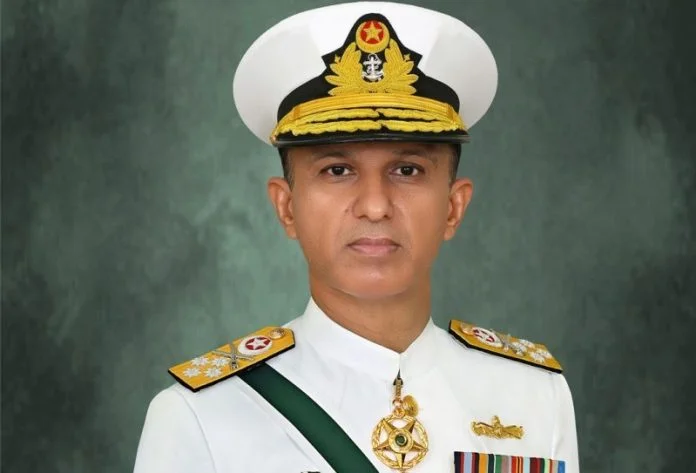
BEIJING, Feb 5 (APP): Chief of the Naval Staff Admiral M. Amjad Khan Niazi has said in cognizance of Pakistan’s geo-strategic location in Indian Ocean at the doorstep of the Arabian Gulf, the Pakistan Navy was playing an important role to promote regional maritime security and good order at sea.
“With the changing geostrategic realities in the region and operationalization of the China-Pakistan Economic Corridor (CPEC), the role and responsibilities of the PN are growing exponentially.
The PN is steadily undertaking capability enhancement and capacity development to optimally deal with added responsibilities and evolving challenges,” he said in an exclusive interview with Global Times, an English-language Chinese newspaper.
During the interview, navy chief shared his visions on Pakistan Navy’s (PN) role in promoting regional maritime security, naval cooperation between the PN and People’s Liberation Army (PLA) Navy China, and the upcoming multinational exercise.
Pakistan, he said, was blessed with an important geo-strategic location on the northern shores of the Indian Ocean and at the confluence of three regions namely the Middle East, Central Asia and South Asia.
“This gives us proximity to the Gulf of Oman which is an important global energy highway as nearly 33% of the world’s oil shipments pass through this area.”
Pakistan’s 90 percent trade is sea borne and most of our energy requirements are also met through the sea. Pakistan’s maritime advantage stems from our over 1,000 kilometres long coastline and the potential offered by our exclusive economic zone of 240,000 square kilometres and continental shelf of 50,000 square kilometres, which is increasingly adding to the national economy.
“In my assessment, the global geopolitical environment is undergoing an unprecedented transition, remaining highly volatile and is characterized by new alignments of interests and partnerships.
Pakistan finds itself in the midst of a complex geopolitical and geo-economic competition prevailing in the region. Pakistan’s maritime security is intertwined with the maritime environment in the Indian Ocean region which is rapidly transforming,” he said.
“In our immediate neighborhood, long drawn instability in Afghanistan simmers and continues to impinge upon regional security.
On our eastern side, India, with an expansionist mindset, is destabilizing the region by actions that could imperil regional security.
On our Western flank, the US-Iran standoff has vacillated, posing risks to ships plying along the international Sea Lines of Communication (SLOCs).
The ongoing conflicts in Yemen and Syria are also impacting regional maritime security. The warring groups’ access to shore-based missiles and remotely operated vehicles is a serious threat to SLOCs transiting the Red Sea and the Gulf of Aden,” Niazi said.
In the nontraditional domain and across the wider region, maritime terrorism, piracy, drugs trafficking and human smuggling were some of the major challenges being faced now.
In short, the challenge to our regional maritime security was an ominous hybrid mix of traditional and nontraditional threats, he added.
To a question regarding Pakistan’s initiative of Regional Maritime Security Patrol and its objectives, Admiral Niazi said, commensurate with the changing geo-strategic realities, PN launched the initiative of Regional Maritime Security Patrol (RMSP) in 2018 to fulfil its international obligations, enhance maritime security and protect its interests in the Indian Ocean region with strategic autonomy.
RMSP was aimed at making seas safer for human use, augment maritime security and contribute to freedom of navigation in the Indian Ocean region.
RMSP sought to create a stable maritime order through “integration rather than alienation.”
Another important objective of RMSP was to foster partnerships with other regional countries and enhance interoperability.
On PLA Navy’s development and its role to security in the Indian Ocean region, he said, the PLA Navy has shown phenomenal progress during the last two decades. Today, the PLA Navy has one of the largest standing fleet in the world and was operating state-of-the-art platforms.
The PLA Navy has been sending its flotilla to the Gulf of Aden since 2009, which has contributed significantly toward maritime security in Indian Ocean region.
The PLA Navy’s participation in various multinational exercises, port visits and humanitarian assistance and disaster relief missions is reflective of its support for collaborative efforts to enhance stability in the Indian Ocean region.
The PLA Navy’s consistent participation in Multinational Exercise AMAN since 2007 and conducting of bilateral exercises have been conducive to the overall maritime security environment in the Indian Ocean region.
Emerging new challenges to maritime security, especially the asymmetric dimension of maritime terrorism, are daunting, which need a collaborative approach.
The PN and PLA Navy with their longstanding and expanding cooperation could play an important role in maintaining good order at sea.
The PLA Navy’s presence in the Indian Ocean region was thus an important element in maintaining the regional balance of power and promoting maritime security, he added.
Regarding the recent major procurement and modernization programs of Pakistan, particularly from China, he said, the PN development strategy was based on “progressive capability enhancement” to create a balanced, potent and combat-ready force to meet evolving threats.
As part of this modernization, PN was replacing its existing ageing platforms with acquisitions from friendly countries along with transfer of technology for their in-country construction.
In this regard, the PN and PLA Navy’s historic and deep-rooted relations constitute a key element.
Admiral Niazi said, the PN has operating Chinese-origin platforms since the early 1970s. Cooperation between the PN and PLA Navy in various domains ranges from construction of naval platforms to bilateral exercises, training and high-level exchange visits.
Naval collaboration between the two countries has been strengthened with the procurement of F-22P frigates, fast attack craft (missile), helicopters and state-of-the-art survey ship.
The PN has also contracted construction of eight Hangor-class submarines, four Type 054A/P ships and medium-altitude long-endurance unmanned combat aerial vehicles from China.
With the changing threat dynamics and enhanced maritime security requirements, induction of modern and potent surface platforms like frigates, corvettes and offshore patrol vessels has assumed greater urgency.
In this regard, Type 054A/P frigates were being acquired from China. These would be one of the most technologically advanced platforms of the PN Surface Fleet, equipped with modern surface, subsurface and anti-air weapons, sensors and combat management systems.
These ships would boost potency of our fleet and significantly contribute in maintaining peace and security in the region, he added.
The contract for acquisition of eight Hangor-class submarines was signed with China Shipbuilding and Offshore International Co Ltd. Of these, four submarines would be constructed in China while the other four would be built in Pakistan.
These submarines, once inducted, would substantially add to the offensive capability
of the PN Fleet.
Besides these, other major programs included enhancing our long-range anti-submarine warfare and anti-surface warfare capability through induction of long-range maritime patrol jets, unmanned combat aerial vehicles and modernizing our existing fleet with state-of-the-art weapons and surveillance systems.
They were also looking at acquisition of modern helicopters, corvettes and
shallow-water attack submarines, he said.
Giving an insight on objectives and conduct on PLA Southern Theater Command participation in the Exercise Sea Guardians-2020 in Pakistan, he said, the Exercise SEA GUARDIANS-2020 was conducted in the North Arabian Sea from January 4 to 14, 2020.
This was the first instance that PN-PLA Navy bilateral exercise was conducted under the ambit of PLA Southern Theater Command.
SEA GUARDIAN series of exercises is aimed at fostering interoperability and sharing professional experiences to deal with contemporary traditional and nontraditional threats in the Indian Ocean region.
The Exercise included joint maneuvers, anti-surface, anti-air and anti-submarine drills. The Exercise provided a useful opportunity to strengthen bilateral naval cooperation and promote safe and secure maritime environment in the region.
On Chinese defense minister’s recent visit to Pakistan and cooperation between navies of China and Pakistan in this year, he said, PN and PLA Navy enjoy long-standing,
broad-ranging and strengthening bilateral relationship.
Close collaboration between the two navies existed across multiple domains including acquisition of platforms, equipment, bilateral exercises, technical cooperation, navy-to-navy expert level staff talks, training collaboration, exchange visits and port calls.
Both navies remained committed to expanding and consolidating this relationship for regional peace and good order at sea, he added.
While commenting on reports claiming that PLA was mulling to build naval base in Pakistan, he said, the Belt and Road Initiative (BRI) was an economic integration initiative of China which would improve inter-connectivity and usher massive growth across regions.
The ongoing CPEC, a flagship project of the BRI, would contribute significantly toward economic prosperity for all stakeholders.
Infrastructure development under the CPEC would create job opportunities and economic development for the people of Pakistan, particularly in Balochistan and along the Makran belt.
The CPEC was a manifestation of strong and fortifying ties between China and Pakistan, that would play a key role in the economic uplift and betterment of the entire region.
Gwadar is a commercial port that will serve as the lynchpin of the CPEC project. As the port gets fully operational, like any other commercial port, it may also receive port calls by ships of different navies.
Karachi Port, for example, received ships of different navies quite often.
Visit of a commercial port by naval ships does not alter the commercial nature of the project.
Moreover, PN was taking all possible measures to ensure protection of Gwadar Port and its seaward approaches through sustained presence in and around the adjoining waters off Gwadar, he added.
When asked whether China’s aircraft carriers would be invited to visit Pakistan, he said, Pakistan maintained close and ever-growing ties with China which has been one of the most steadfast and reliable partners for peace in the region.
Chinese Navy hosts a number of modern and technologically advanced platforms in their inventory. Operating with these modern and high-tech platforms afforded an opportunity to refine our tactics and procedures.
The PN and PLA Navy held regular bilateral (Exercise SEA GUARDIAN) and multilateral (Exercise AMAN) exercises.
The PN would like to conduct an exercise with these carriers whenever an opportunity arises. Moreover, the PLA Navy and PN ships regularly visited each other’s ports.
In the same stride, the PN would continue to welcome further visits by PLA Navy ships, including aircraft carriers, he said.
To a question about initiatives being taken by Pakistan in terms of defense diplomacy with neghboring countries and major naval forces, he said, “We are a peace-loving nation and strive to maintain peaceful and cordial relations with all our neighbors and regional countries.
In line with this national policy, the PN has been playing its role by actively engaging with the navies of all littoral states in the Indian Ocean region and beyond.”
Admiral Niazi said, the PN, through naval diplomacy, contributes to the nation’s foreign policy objectives by showing Pakistan’s flag in countries far and wide; through key leadership engagements; navy-to-navy expert level talks; overseas deployments; and participation in bilateral/multilateral exercises on a regular basis.
In 2019-20, PN ships proceeded on deployment around Africa in line with the government’s “Engage Africa Policy.”
A PN ship was currently on a humanitarian assistance and disaster relief and goodwill mission to extend support and deliver food aid to African countries hit by floods and droughts.
The PN also projected Pakistan’s maritime perspective at international fora and was a member of the Indian Ocean Naval Symposium and an observer in the Western Pacific Naval Symposium.
To the vision behind organizing of Multinational Exercise Aman in the region and importance of exercises for other countries in the region, he said, Pakistan as a responsible maritime state has consistently contributed to advancing peace and stability in the region.


