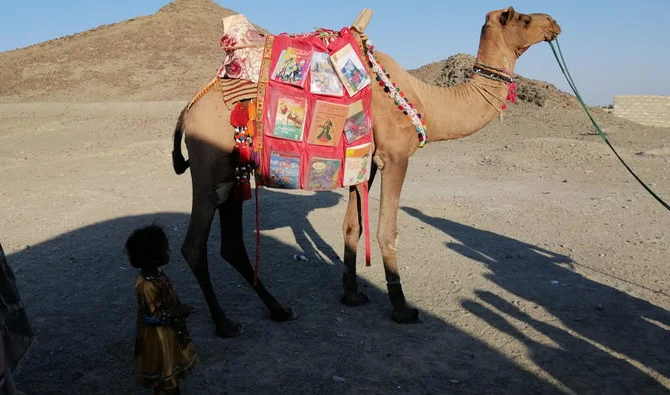
QUETTA: In a remote part of Pakistan, two women and a charity have come up with a novel idea to help children continue reading and learning — a camel bearing books. Pakistan closed its schools in March and sent over 50 million school and university-going Pakistanis home. The closures have put children in Balochistan at particular risk of falling behind, as the province is Pakistan’s most impoverished, with few schools and the lowest literacy rate in the country. According to data from the Pakistan Bureau of Statistics, up to 62 percent of children between the ages of 5 and 16 are out of school in rural areas of Balochistan. With the coronavirus pandemic threatening even more children, two sisters from Balochistan, Raheema Jalal, the principal of the Zubaida Jalal Girls High School, and Zubaida Jalal, the Pakistani minister for defense production, thought: if children couldn’t go to school, why not take the books to them?
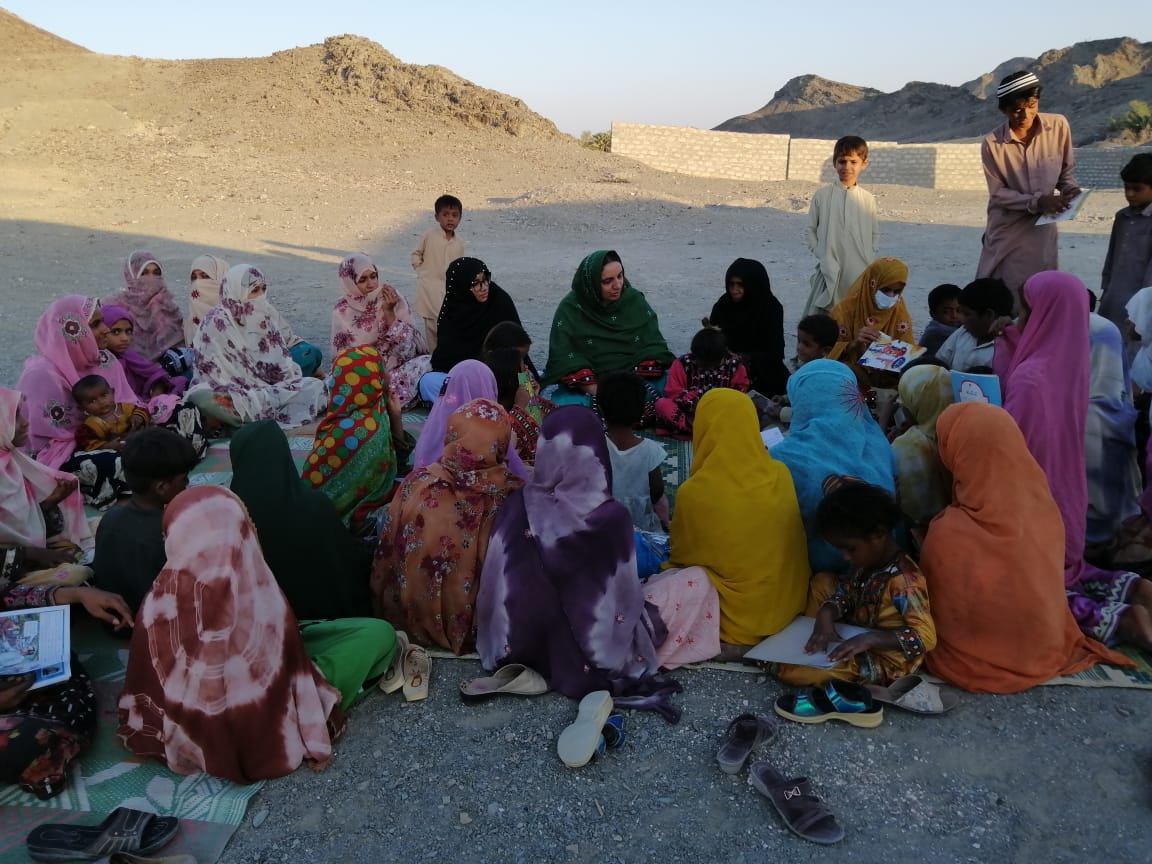
Women and children gather to read books in Kech district, Balochistan, Pakistan, on November 6, 2020 (Photo courtesy: Haneefa Abdul Samad)
The sisters, who run the Female Education Trust Balochistan (FETB), reached out to the Alif Laila Book Bus Society (ALBBS), which has established more than 7,000 mobile libraries across Pakistan, with over 1.5 million books donated in the past four decades. In collaboration, they launched a mobile library that deploys local herder, Murad Dur Muhammad, and his 12-year-old camel, to carry books to help hundreds of children continue their education in Balochsitan’s remote Kech district. The idea had previously been used in Ethiopia by Save the Children. “When Zubaida Jalal learnt that camel libraries were being used in Ethiopia she thought of the joy such libraries could bring to children in Mand [a town in Balochistan province] and how they could help raise the literacy rate in the area,” said Syeda Basarat Kazim, president of the Alif Laila Book Bus Society. “Alif Laila approached the Judith’s Reading Room with a proposal,” Kazim said, referring to a US-based organization that runs libraries in 22 countries. “The board of governors chose this as their board option prize and Mand’s camel library became the 101st Judith’s Reading Room library.” Alif Laila prepared the library, named the camel, purchased books, games, puzzles and puppets in record time and the library was launched in October, Kazim said. The camel was named Roshan, or bright light, Reheema Jalal said, “because he has been lighting [the path of] education for the deprived children of Balochistan.”
Since October 2, Roshan has taken his library of fifty books to six villages of Mand. Over 150 children have borrowed books from the program in the past six weeks, Raheema said. The titles are in both Urdu and English and include storybooks, and books of general knowledge, science and Islamic studies. A majority of the children targeted are from grades one to six, but secondary school students have also borrowed books from the mobile library. “Roshan supplies the books on Friday, Saturday and Sunday and covers three different villages every week,” Raheema said. “The library is open for two hours, from 4 p.m. to 6 pm. Children choose the books they like and return them after a week.”
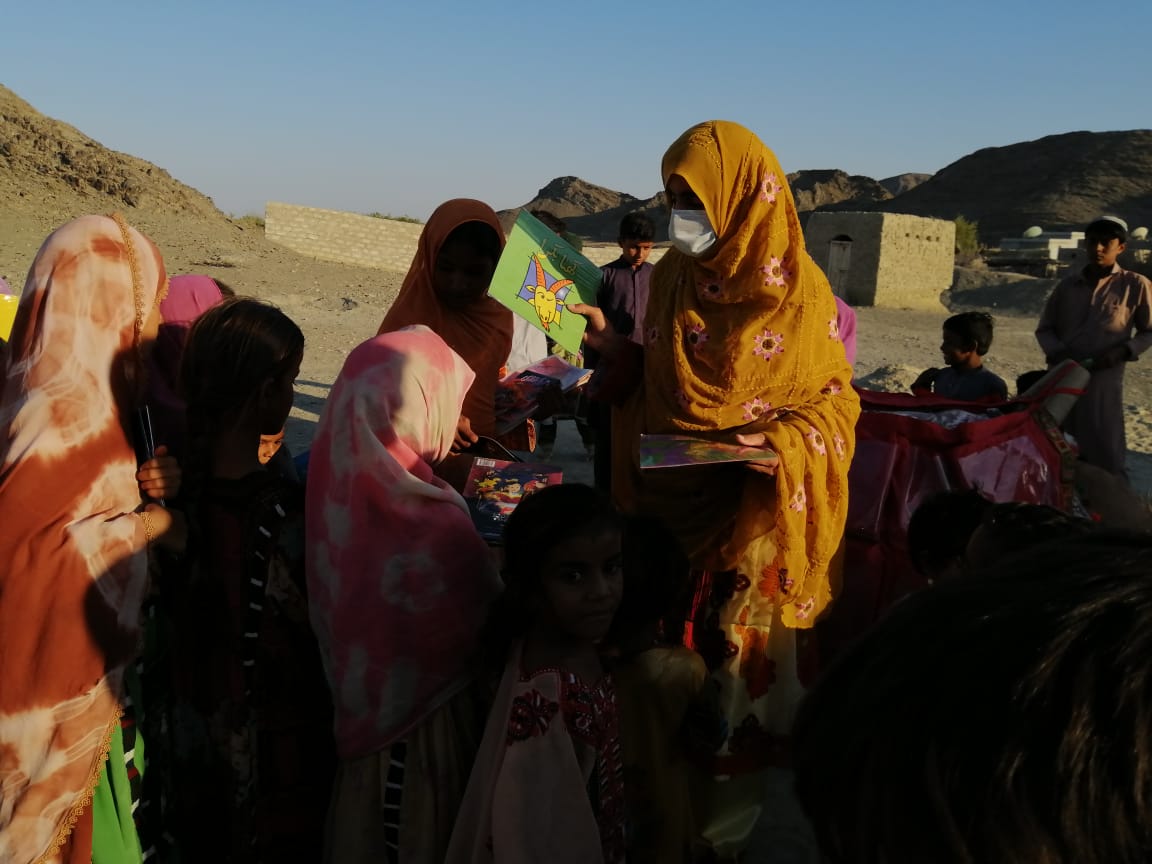
Women and children gather to read books in Kech district, Balochistan, Pakistan, on November 6, 2020 (Photo courtesy: Haneefa Abdul Samad)
Roshan and Muhammad are also often accompanied by Haneefa Abdul Samad, a 30-year-old science and math teacher, who supports the duo by helping answer the children’s queries. “Initially, I was reluctant as to how the idea would work in remote villages,” Samad, who is also the coordinator of the project, said. “But after seeing the reaction and love of children toward books, I decided to accompany Roshan to every single village of Kech.”
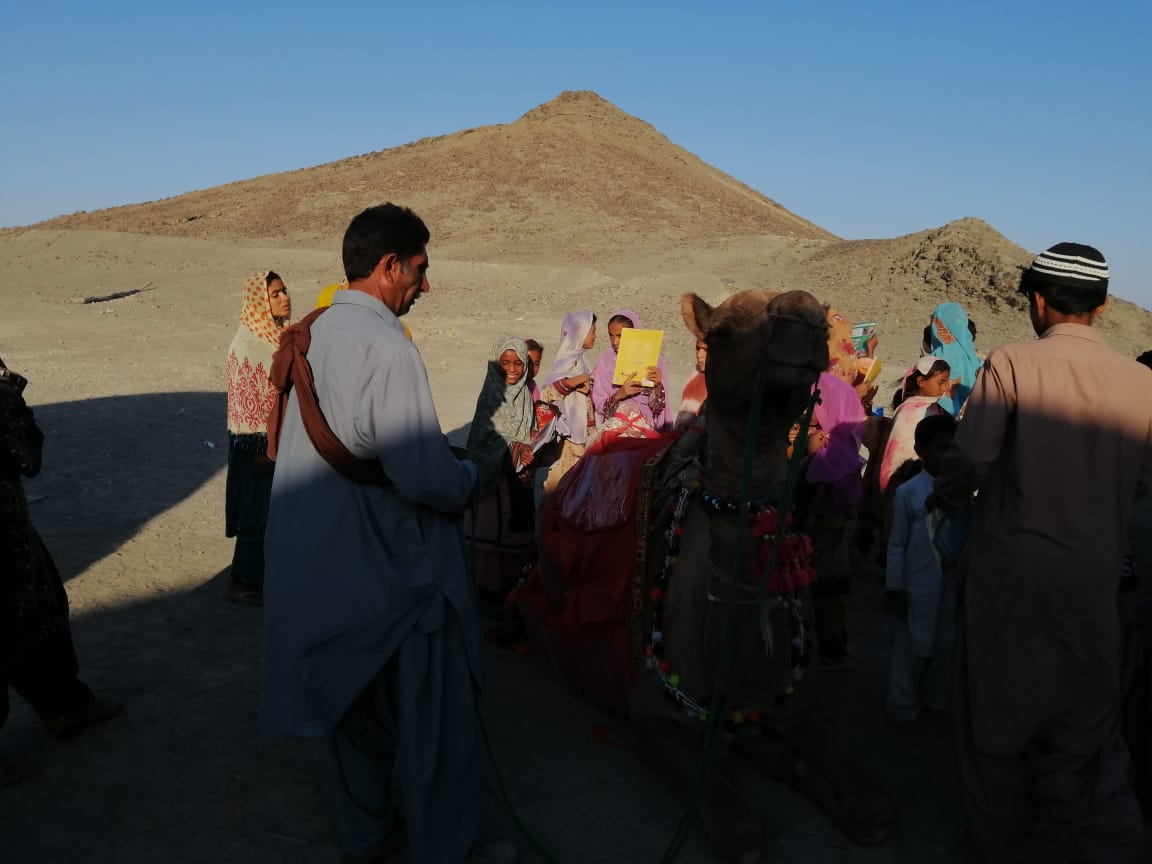
Locals gather around 12-year-old camel, Roshan, who carries books to help hundreds of children continue their education in Kech district, Balochistan, Pakistan, on November 6, 2020 (Photo courtesy: Haneefa Abdul Samad)
“As Pakistan grapples with the deadly coronavirus, and educational activities across the country are yet to be fully restored, the camel library has been engaging children to continue their studies and attachment with books,” Samad added. One such student is Sara Abdul Rauf, a seventh grader from the Koh-e-Pusht village, who eagerly awaits Roshan’s visits. “Not [just] me, but all the children, especially girls, are very happy with the camel library,” the 14-year-old, who wants to be a doctor, said. “It has been providing us with books at our doorsteps.” The initial plan for the camel library was to reach “as many villages as possible” over a three-month period. But Raheema now hopes, with Alif Laila’s help, to expand the project to other areas of Kech and hire more camels to keep Roshan company. “We had planned this program till December,” she said. “Fortunately, we have received a positive response from the children. After December, we will look for more donors and hire more camels to reach more villages of Kech.”
Reading is the strategy to relieve you from conflicts and libraries are the guardhouses for reading. It is the best policy that can lead you everywhere. One can easily move to the history of many centuries ago and can visualize the exact scenario. It takes to the trip of imagination and far beyond. Reading allows meeting with imaginative characters. They are able to talk and walk with the products of imagination. It has the strongest power to strengthen your opinion. I would like to quote George R.R Martin who says that: “A reader lives a thousand lives before he dies.”
Moreover, reading introduces you to an unknown world where you can find the flavor of your life. It is the best friend of escapism. Reading books bless you with the treasure of knowledge. Garrison Keillor well said about the book: “A book is a gift you can open again and again.” Reading is a culture and it has led developed countries towards their developments. So why not develop this culture among the people.
Hence, to develop this culture there must a range of libraries. Libraries are the places that can motivate people toward reading culture. Building libraries do not charge that much amount but become the liveliest buildings. Such buildings are museums in themselves and engage people from reality to imagination. The walls decorated with books give the feeling of excitement and curiosity. Because once you become habitual of reading you can leave the world but not your reading habit.
Moreover, reading lets you put your feet in someone else shoes and walk on their behalf. It makes you like to feel things, to learn more, and to grasp a lot of experiences. In this way, it teaches you things before time. Foremost, it allows you to explore the world. Empower you to conquer the world through your imagination. Arouses your emotion and makes you a human being.
Every society, community, and family needs a building of books. There must be at one public library if not more than that so that the people can make their mind towards reading culture. A proper library setup can persuade most people toward reading culture. I grantee you when the people are engrossed into reading culture then there is no power to distract them. And every household will furnish their one wall for books. That would be amazing.
The well-known Muslim scientist Abū al-Qāsim al-Zahrāwī, also spelled Abul Kasim, in full Abū al-Qāsim Khalaf ibn ʿAbbās al-Zahrāwī, Latin Albucasis, was born in 936, near Córdoba Spain. He had his origin from the Medinan tribe of Al-Ansar. He lived most of his life in Cordoba. It is also where he studied, taught, and practiced medicine and surgery. He was a medieval surgeon of Andalusian Spain, whose comprehensive medical text, combining Middle Eastern and Greco-Roman classical teachings, shaped European surgical procedures until the Renaissance.
The Surgical Man
Al-Zahrawi remained the greatest surgical man. He specialized in curing disease by cauterization. And invented several devices used during surgery, for purposes such as inspection of the interior of the urethra. He also used surgical devices in applying and removing foreign bodies from the throat, the ear, and other body organs. The man of cure is ranked as the first to illustrate the various cannulae and the first to treat a wart with an iron tube and caustic metal as a boring instrument. He had performed laryngotomy on a slave girl without any experience but became successful and called it not dangerous.
Moreover, Al-Zahrawi is also considered to be pioneered neurosurgery and neurological diagnosis. He is known to have performed surgical treatments of head injuries, skull fractures, spinal injuries, hydrocephalus, subdural effusions, and headache. Al-Zahrawi had given the first clinical description of an operative procedure for hydrocephalus. And clearly described the evacuation of superficial intracranial fluid in hydrocephalic children. Other than this he had written a complete code of surgical conduct that is used by modern surgeons. He had made many surgical tools that became the base for the development of advanced tools.
His Book Kitab al-Tasrif
Al-Zahrawi’s Kitab al-Tasrif is a medical encyclopedia comprised of thirty volumes that he completed in the year 1000. It covered a broad range of medical topics, including surgery, medicine, orthopedics, ophthalmology, pharmacology, nutrition, dentistry, childbirth, and pathology. The first volume in the encyclopedia is concerned with general principles of medicine, the second with pathology, while much of the rest discuss topics regarding pharmacology and drugs. The last treatise and the most celebrated one is about surgery. Al-Zahrawi stated that he chose to discuss the surgery in the last volume because surgery is the highest form of medicine, and one must not practice it until he becomes well-acquainted with all other branches of medicine.
The work contained data that had accumulated during a career that spanned almost 50 years of training, teaching, and practice. In it, he also wrote of the importance of a positive doctor-patient relationship and wrote affectionately of his students, whom he referred to as “my children”. He also emphasized the importance of treating patients irrespective of their social status. He encouraged the close observation of individual cases in order to make the most accurate diagnosis and the best possible treatment.
The wise surgeon once said about anatomy: “Before practicing surgery one should gain knowledge of anatomy and the function of organs so that he will understand their shape, connections, and borders. He should become thoroughly familiar with nerves muscles bones arteries and veins. If one does not comprehend anatomy and physiology one can commit a mistake that will result in the death of the patient. I have seen someone incise into a swelling in the neck thinking it was an abscess when it was an aneurysm and the patient dying on the spot.”
In short, he had given complete documentation and procedure along with a description. He has made the world of surgery.